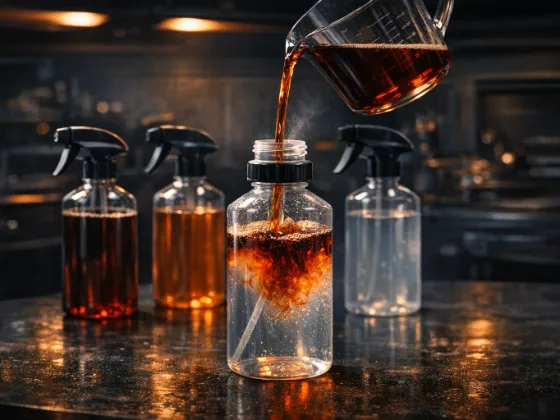
Detailing products are concentrates. The ratio you mix them at determines whether you get cleaning power, safety, and value — or damage, waste, and frustration. Most people use concentrates too strong. A few use them too weak. Almost everyone is working without a real understanding of what the ratio number means. That changes here.
How to Read a Dilution Ratio
Dilution ratios are written as two numbers separated by a colon: 1:10, 1:20, 1:100. The format is always product:water.
1:10 means 1 part product to 10 parts water — you're making a solution that's about 9% product and 91% water.
1:20 means 1 part product to 20 parts water — about 5% product and 95% water.
1:100 means 1 part product to 100 parts water — about 1% product and 99% water.
Here's the counterintuitive part that trips people up: a higher second number means more dilution, which means a weaker solution. 1:100 is weaker than 1:10. When you want more cleaning power, you decrease the second number (add less water). When you want a gentler solution, you increase the second number (add more water).
The Practical Math
To mix a dilution in a specific container, you need to know the volume you're filling. Then:
Amount of product needed = Total volume ÷ (ratio + 1)
Example: You want to fill a 1-liter spray bottle at 1:10.
- Total volume = 1000ml
- Product needed = 1000 ÷ (10 + 1) = 1000 ÷ 11 = ~91ml
- Water = 1000 - 91 = ~909ml
Example: Same bottle, 1:20 dilution.
- Product needed = 1000 ÷ (20 + 1) = 1000 ÷ 21 = ~48ml
- Water = 1000 - 48 = ~952ml
In practice, most detailers round these numbers. For a 1:10 dilution in a 32oz sprayer, using 3oz of product and filling the rest with water gets you close enough. Precision matters more for some products (certain paint sealants, products applied to sensitive surfaces) than others (general-purpose cleaners, wheel soap).
Why Stronger Isn't Always Better
More concentrated = more cleaning power. That's true, but it stops being an advantage and starts becoming a problem at a certain point. There are several reasons.
Surface Damage
Products formulated as concentrates are calibrated for a specific pH range and chemical activity at their recommended dilution. Using them at half the recommended water content doesn't just clean twice as well — it can push the pH into a range that damages paint, strips protection, degrades rubber, or etches aluminum.
A degreaser at 1:10 dilution might be perfectly safe on painted surfaces. The same product at 1:4 dilution might strip wax, dry out rubber seals, and cloud plastic trim. Same product, different outcome based purely on concentration.
Residue and Resoiling
Concentrated solutions leave heavier chemical residue that's harder to rinse completely. Residue on painted surfaces attracts dirt, leaves streaks and films, and in some cases can cause water spot formation. A properly diluted product rinses clean; an overly concentrated one leaves a film that makes the surface look worse than before cleaning.
Foam Cannon Problems
Foam cannons have a specific dilution range where they produce the best foam. Too concentrated and the foam is dense but quickly collapses and drains fast. Too diluted and the foam is thin and watery. The sweet spot varies by product, but it's a specific range — not "more is better."
Cost
This one's obvious but worth stating: if a product at 1:20 dilution cleans effectively and you're mixing it at 1:5, you're using four times as much product. Concentrates are where most of the cost is. Using them at the right dilution is where you get the economy.
Why Too Weak Fails Too
The opposite mistake — over-diluting — means the cleaning chemistry is so thin that it can't actually do the job. You end up with a product that looks like it's working (it's wet, it's making the surface look clean temporarily) but isn't actually removing contamination. When the surface dries, the grime is still there and has just been redistributed around the panel.
This is especially a problem with degreasers used on heavy contamination. Insufficient concentration means the product can't emulsify the grease you're trying to lift — it just pushes it around.
Surface-Specific Dilution Ranges
Most multi-purpose concentrates specify different dilutions for different applications. This isn't arbitrary — it reflects the different contamination levels and surface sensitivities you're dealing with.
A typical all-purpose cleaner might specify:
- 1:4 — heavily soiled engine bays, wheel wells, floor mats
- 1:10 — regular wheel cleaning, exterior trim
- 1:20 — interior hard surfaces, slightly dirty painted surfaces
- 1:40 — delicate interior materials, general maintenance cleaning
The same bottle is doing completely different work at different points in that range. Understanding this means you can often do more with fewer products — a good versatile concentrate at the right dilution replaces several single-use products.
Foam Cannon vs. Bucket Dilutions
Foam cannons and wash buckets use different dilutions of the same shampoo. In a bucket, you want a soapy solution that you can pull from with a wash mitt — typically 1:100 to 1:200 for a high-lubricity car shampoo. In a foam cannon, the product hits the panel at much higher concentration because the cannon is designed to produce foam, not apply a diluted solution. Foam cannon dilutions typically run 1:10 to 1:30.
If you use your bucket dilution in a foam cannon, you'll get watery mist with no foam. If you use your foam cannon dilution in a bucket and try to work from it, you'll have so much sudsing that it's hard to see what you're doing and hard to rinse off. These are different tools with different dilution requirements.
Distilled vs. Tap Water
The water you dilute with affects the performance of the final solution. Hard tap water contains calcium and magnesium minerals that react with some cleaning chemistry, reducing effectiveness and sometimes causing cloudiness in the mixed solution. For products you're spraying directly on paint and not rinsing immediately, distilled water is the better choice — it introduces no mineral content that could leave deposits.
For high-rinse applications like bucket washing (where you're rinsing thoroughly with a hose anyway), tap water is generally fine. For spray detailers, interior cleaners, and products used in small quantities that dry on the surface before removal, distilled water produces better results.
The Bottom Line
Read the label. Use the recommended dilution for the surface and contamination level you're dealing with. Don't go stronger "just to make sure" — you're risking surface damage and creating more cleanup work. Don't go weaker "to be safe" — you're wasting time on a product that can't do the job at that concentration.
Dilution is a variable you control. Use it deliberately.