If you've spent any time in detailing forums or watched paint correction videos, you've seen people spray something on a panel, wipe it down, and call it an "IPA wipedown." It looks like a minor step. It isn't. Understanding what IPA actually does — and why it matters at specific points in the process — makes you better at every step that comes after it.
What IPA Is
IPA stands for isopropyl alcohol — also called isopropanol or rubbing alcohol. It's a simple alcohol solvent with a few properties that make it extremely useful in detailing:
It dissolves oils and waxes. IPA is miscible with most organic compounds, including the oils in polish residue, wax, sealant, dressing overspray, and fingerprints. It strips these off paint surfaces effectively without leaving its own residue behind.
It evaporates quickly and completely. Unlike water, IPA evaporates at room temperature and leaves nothing behind. No mineral deposits, no film, no residue. When IPA flashes off the panel, the surface is chemically bare.
It's not aqueous (water-based). IPA won't raise grain in fabric or cause corrosion on bare metal the way water can.
What IPA Is Used for in Detailing
Pre-Coating Panel Wipedown
This is the most critical use. Before applying any ceramic coating, paint sealant, or wax that needs to bond to clean paint, the panel needs to be free of all oils, polish residue, and silicone. An IPA wipedown removes all of that.
Why does it matter? Even perfectly polished paint has polish oils and carrier solvents sitting on the surface from the polishing process. These create a barrier. If you apply a ceramic coating on top of them, the coating bonds to the oil layer — not to the paint. The result is poor durability, uneven curing, and potentially easy flaking. IPA strips that layer and gives the coating direct contact with the clear coat.
This is not a step you can skip or replace with a good wipe-down with a microfiber. Microfiber removes particles. IPA dissolves oils.
Post-Polish Panel Inspection
Polish and compound leave behind oils and fillers that temporarily fill in light scratches and make the surface look better than it actually is. These fillers are deliberately included in most polishes — they make the finish look great right after polishing.
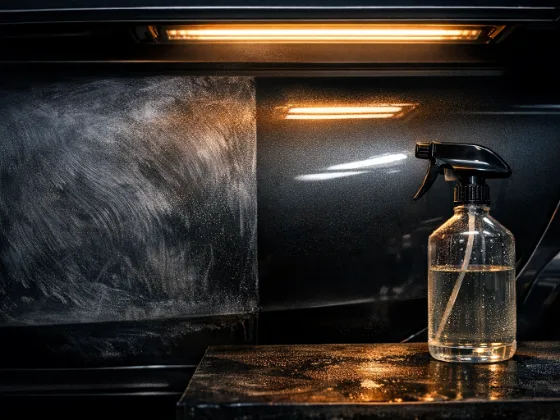
But if you want to see the true correction results — what the paint actually looks like after the work is done — you need to strip those fillers. An IPA wipedown reveals the honest surface. Scratches that were "hiding" under filler reappear. That's useful because it tells you whether you actually need more correction work, or whether you're looking at a surface that's ready for protection.
Professional detailers do this during multi-stage corrections to evaluate each stage honestly. The filler-free view is the real view.
Removing Dressing Overspray
Tire dressings, trim restorers, and rubber conditioners are oily or silicone-based. If they splash or mist onto paint during application, they leave slick residue that needs to come off before you apply any protection. IPA removes these efficiently without needing to rewash the whole car.
Glass Prep Before Rain Repellent
Rain repellent coatings applied to windshields need a clean, oil-free glass surface to bond properly. Wiping glass with IPA before application removes any film, cleaner residue, or wiper fluid chemistry that would interfere with bonding.
The Concentration Question
IPA products come in different concentrations. This matters a lot.
70% IPA is what you find in drugstores labeled "rubbing alcohol." The 30% water helps with some germicidal applications, but in detailing, that water is a problem — it can leave water spots, and the slower evaporation means more dwell time and more risk.
91% IPA is widely available and adequate for most detailing applications. Evaporates faster, leaves less behind, and is strong enough to strip oils effectively.
99% IPA is what professionals typically use for pre-coating wipedowns. Maximum solvent strength, fastest evaporation, no water residue. The standard choice before applying any ceramic coating.
The higher the concentration, the more aggressively it strips oils. For a pre-coat wipedown, that's exactly what you want. For just removing fingerprints before an inspection, 91% is fine.
The Critical Safety Rule: Never Use Straight IPA on Paint in Direct Sunlight
Pure isopropyl alcohol can craze or cloud clear coat if applied to a hot panel in direct sunlight and left to evaporate slowly while the panel is hot. The mechanism is thermal shock combined with solvent penetration into soft clear coat.
IPA wipedowns are done in shade, on cool panels, with quick application and removal. Apply to a microfiber first, not directly from a bottle onto the panel. Wipe across the section and follow immediately — don't let it sit.
This risk is dramatically reduced by using diluted IPA (70–80% rather than 99%) for general use. The full 99% concentration is reserved for the final pre-coat wipedown where complete oil removal is critical and you're controlling conditions carefully.
How to Do an IPA Wipedown
The process is simple but technique matters:
- Work in shade with a cool, clean panel.
- Spray IPA onto a clean, lint-free microfiber — not directly on the paint.
- Wipe in straight, overlapping passes with light pressure.
- Follow immediately with a dry side of the microfiber or a second clean microfiber to pick up the solution before it fully evaporates on the panel.
- Work one panel at a time. Don't try to do the whole car and then go back.
After a thorough IPA wipedown, don't touch the panel with bare hands — the oils from your skin contaminate the surface immediately. Put on nitrile gloves if you're applying a coating.
What IPA Doesn't Do
IPA removes oils and dissolvable residues. It doesn't:
- Remove bonded contamination (iron particles, tree sap, water spot etching)
- Polish out scratches or swirl marks
- Substitute for iron remover or decontamination steps
- Remove paint overspray
An IPA wipedown is the final step before protection, not a substitute for the decontamination and correction steps that come before it.
DIY IPA Spray
Many detailers make their own IPA spray: dilute 99% IPA with distilled water to get a 70–80% solution. Use a quality sprayer. Label it clearly. Keep it away from heat sources — IPA is flammable.
Commercial IPA wipe products are also available and often include a small amount of surfactant or lubricant to reduce the streak risk. Either approach works. The end result — stripped oils, chemically clean paint — is the same.
The Bottom Line
IPA is inexpensive, widely available, and irreplaceable for specific steps. You cannot properly prep a panel for ceramic coating without it. You can't honestly evaluate your paint correction results without stripping the polish fillers. Every professional detailer has IPA in their kit. You should too.