If you've shopped for a ceramic coating in the last few years, you've seen the "9H hardness" claim everywhere. Almost every consumer ceramic coating product — from budget sprays to premium professional installs — claims 9H hardness. It's on the bottle, in the ads, on review sites. It's become shorthand for "this is a serious protective product."
The problem is that most people don't know what 9H actually measures. And when you find out, the marketing looks significantly less impressive.
What the "H" Scale Actually Is
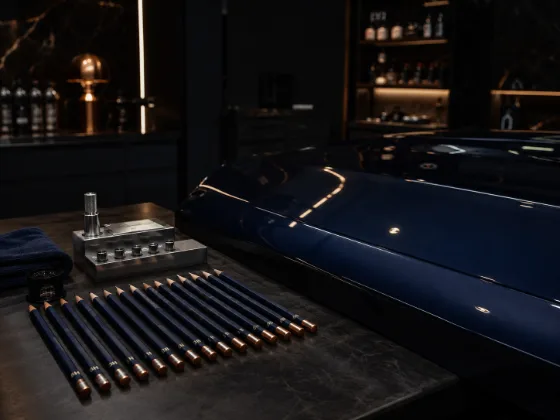
The "H" scale is the pencil hardness scale — also called the Wolff-Wilborn scale. It was developed to test the hardness of paint and coatings in manufacturing, not to evaluate automotive protection. The test works exactly like it sounds: pencils of increasing hardness are pressed against the surface at a 45-degree angle and dragged across it. The hardness rating is determined by which pencil leaves a mark and which doesn't.
Pencil hardness ratings run from 9B (softest) through B, HB, F, H, 2H, 3H, all the way up to 9H (hardest). 9H pencil lead is extremely hard — a specific grade of graphite that resists scratching.
When a ceramic coating claims 9H hardness, it means the cured coating can resist being scratched by a 9H pencil pressed against it at 45 degrees under test conditions. That's it. That's the claim.
Why 9H Doesn't Mean Scratch-Proof
Here's the critical point that gets obscured in the marketing: the pencil hardness scale is not the same as the Mohs hardness scale, which measures material hardness in the traditional mineralogical sense.
A 9H pencil is made of graphite, which has a Mohs hardness of roughly 1.5–2 — one of the softest minerals that exists. A 9H result on the pencil scale means the coating resists graphite scratching it. That's a very low bar for hardness.
By comparison, a car key has a Mohs hardness of around 5.5–6.5. Sand (silica, the same material that makes up the bulk of road grime and the abrasive in many car wash brushes) has a Mohs hardness of 7. A 9H ceramic coating can resist being scratched by 9H pencil lead. It cannot necessarily resist being scratched by a car key, sand, or a dirty wash mitt dragged across it under pressure.
This is not a failure of ceramic coatings — it's a failure of marketing to accurately represent what the hardness rating actually means.
What Ceramic Coatings Actually Do for Scratch Resistance
Despite the misleading marketing around 9H, ceramic coatings do provide real scratch resistance benefits — just not in the way the advertising implies.
They're harder than the clear coat they protect. Automotive clear coat typically rates around 2H–4H on the pencil scale. A 9H ceramic coating is genuinely harder than the paint it's protecting. This means surface marring, fine abrasion, and micro-scratches that would affect unprotected clear coat are resisted by the coating. The coating takes the damage instead of the paint.
They provide a sacrificial surface. When a ceramic coating does get scratched, the scratch is in the coating, not in the clear coat beneath it. In theory, severe enough damage can be polished out of the coating while leaving the paint intact — though in practice this usually means removing the coating along with the scratch and reapplying.
They resist chemical etching. This is actually more significant than scratch hardness for most owners. Bird droppings, insect acids, tree sap, brake dust, and industrial fallout all attack paint chemically. Ceramic coatings resist these chemical attacks much more effectively than wax or sealant because the SiO2 matrix is chemically inert. The coating takes the chemical attack instead of the clear coat.
They're not impervious to swirl marks. This is the big one. Swirl marks — the fine, circular scratches that make paint look dull under direct light — come from improper washing technique, dirty towels, automatic car washes, and careless contact with the paint surface. A 9H ceramic coating does not prevent swirl marks from improper washing. A dirty microfiber dragged across a ceramic-coated hood will still create swirl marks. The coating reduces their severity compared to uncoated paint, but it doesn't eliminate the risk.
The Companies That Know Better
Ironically, the most credible ceramic coating companies are the ones that say very little about 9H in their marketing. They focus on durability, chemical resistance, hydrophobic performance, and application requirements — the things that actually differentiate their product. The brands that lead with "9H HARDNESS!" as a headline claim are often the ones relying on consumer misunderstanding of what the scale means.
This isn't universal — some high-quality brands use the 9H claim accurately as one data point among many. But if "9H hardness" is the primary benefit being advertised, it's worth reading more carefully before buying.
What Actually Protects Against Scratches
If scratch resistance is your primary concern, the coating's hardness rating is not the most important variable. Here's what actually matters:
Proper washing technique. The vast majority of swirl marks and fine scratches come from contact during washing — not from road debris or environmental exposure. Two-bucket method, pH-neutral shampoo, clean microfiber media, and straight-line wiping patterns are more important for scratch prevention than any product you apply.
Pre-wash procedures. Rinse the car thoroughly before making contact. Use a foam pre-wash that dwell on the surface and release contamination before your mitt touches the paint. The less contamination present when you make contact, the fewer scratches result from washing.
Paint film protection. Clear paint protection film (PPF) is the only product that actually provides meaningful impact protection and scratch resistance against real-world hazards — rock chips, key scratches, parking lot contact. PPF is physically thick enough to absorb impacts that no coating chemistry can resist. For a car that needs true scratch protection in high-risk areas, PPF over ceramic coating is the right combination.
The Honest Bottom Line on 9H
9H hardness is a real and measurable property of ceramic coatings. It genuinely means the cured coating is harder than the clear coat beneath it, and that translates to real but limited scratch resistance benefits — primarily against fine abrasion and micro-marring, not against keys or grit.
What 9H doesn't mean: scratch-proof, invincible, or protected from the washing-induced swirl marks that actually account for most paint damage on well-kept cars.
Ceramic coatings are excellent products that provide real benefits — UV protection, chemical resistance, hydrophobic performance, long-term durability. Choose one for those reasons. The hardness rating is a minor footnote to those real benefits, not the headline it's being marketed as.