
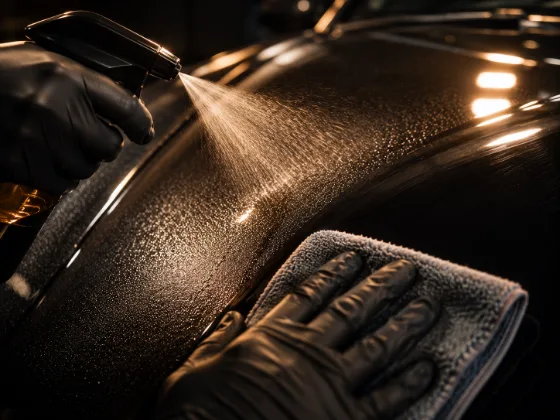
Spray wax gets a bad reputation in some detailing circles because people treat it like an air freshener — spray it everywhere, wipe it off, done. Applied that way, you get uneven coverage, streaks, and a fraction of the protection the product can actually deliver.
Applied correctly, spray wax is one of the most efficient steps in car care. Two minutes after a wash and your paint has a fresh sacrificial layer, better water behavior, and noticeably more gloss. Here's how to do it right.
When to Apply It
Spray wax should go on clean, wet or damp paint — right after washing and before drying, or on already-dry paint depending on the specific product. Read your product label on this. Some spray waxes are formulated to work on wet panels (rinse aids), others need the panel dry enough to wipe without streaking.
The most common approach: wash the car, then work panel by panel — spray the product, spread it with a microfiber, flip to a dry side and buff. You're essentially drying and waxing at the same time.
Never apply spray wax in direct sunlight or on hot paint. The carrier evaporates too fast, the product dries before you can spread it evenly, and you get haze and streaks that require extra buffing to remove. Work in shade or indoors, or wait until the surface cools after a drive.
What You Need
- Your spray wax
- Two clean microfiber towels per panel (one to spread, one to buff)
- A clean, freshly washed car
That's it. The microfiber situation matters more than most people think. A single dirty or contaminated towel drags debris across the paint as you work. Keep your applicator towels clean and separate from your drying and general-purpose towels.
The Application Process
Step 1: Work one panel at a time. Don't spray the whole car and then start wiping. The product sets up while you're working other panels and you'll be chasing haze. Panel by panel keeps the chemistry working for you.
Step 2: Spray 3–4 times per panel. Hood, roof, trunk, doors — these are large surfaces. 3–4 light sprays distributed evenly across the panel is about right. For smaller panels (pillars, mirror caps), 1–2 sprays is enough. More product doesn't mean more protection; it means more buffing effort to remove the excess.
Step 3: Spread with overlapping passes. Use a clean microfiber in straight-line passes — left to right, then top to bottom. You're spreading a thin even film across the surface, not scrubbing. Light pressure. The goal is coverage, not friction.
Step 4: Flip or switch to a fresh towel and buff. Once the panel is evenly covered, use the dry side of your towel (or switch to a fresh one) and lightly buff the panel in the same straight-line pattern. This removes the carrier and any slight residue and leaves behind the protective layer with a high-gloss finish. Very little pressure needed here — you're just removing, not polishing.
Step 5: Check your work before moving on. Look at the panel from a low angle against a light source. Any haze, high spots, or missed areas show up immediately at this angle. Touch them up before moving to the next panel.
Common Mistakes
Spraying on hot paint. Mentioned above but worth repeating. Hot panels are the single biggest cause of spray wax streaking and haze. Let the car cool down first.
Too much product. More spray wax is not better. Excess product just has to be buffed off — you're not adding more protection, you're creating more work.
Using the same dirty towel for the whole car. Your first towel panel picks up any residual dirt that didn't come off in the wash. Using that contaminated towel on the rest of the car is dragging that contamination across the paint. Use clean towels or rotate frequently.
Letting it sit too long. Spray wax is designed to be spread and buffed immediately. It's not a product that needs dwell time to cure. If you spray and walk away for ten minutes, you're creating extra work for yourself.
Skipping the pre-wash. Spray wax applied over contaminated paint is spray wax sealing dirt against your clear coat. Proper washing first isn't optional — it's the foundation that makes the wax step meaningful.
How Long Does It Last?
Spray wax applied once typically lasts 2–6 weeks depending on exposure, wash frequency, and the specific product. That's why consistency matters more than any single application. If you apply it after every wash, you're maintaining a continuous layer of protection even though each individual application has short durability.
Think of spray wax as a maintenance product, not a one-time treatment. The car that gets spray wax applied after every single wash has far better paint protection over the course of a year than a car that gets a full paste wax applied twice and nothing in between.
Does Spray Wax Work Over Other Protection?
Yes — this is actually one of the best uses. Spray wax applied over a ceramic coating or paint sealant adds a sacrificial wax layer on top of the base protection. The wax gets consumed by washing and UV first, and your ceramic or sealant underneath stays intact longer. This is the professional maintenance approach: long-lasting base protection + regular spray wax top-up after each wash.
The Bottom Line
Spray wax is only as effective as the technique behind it. Panel by panel, right amount of product, clean towels, shade or cool paint — follow those basics and a two-minute step delivers real, consistent protection. Skip them and you're going through product and effort without the results.