
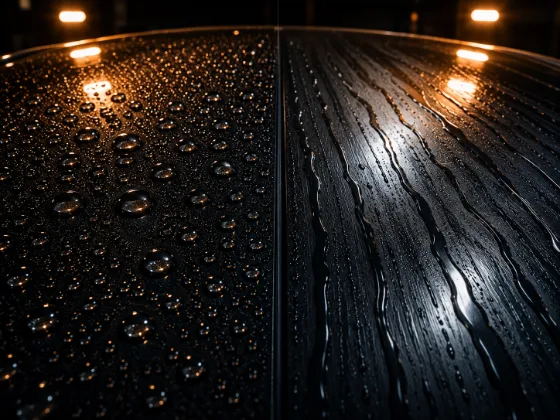
Everyone loves watching water bead up on a freshly waxed car. Those tight, round beads rolling across the panel look great and feel like proof the protection is working. But there's another type of water behavior that's actually a sign of stronger protection — water sheeting — and most people misread it as a sign their product has worn off.
Understanding the difference isn't just trivia. It tells you what type of protection you have, how it's performing, and when it might actually be wearing down.
What Water Beading Is
Water beading happens when the surface has high contact angle — the water droplet sits up on the surface, barely touching it, and the surface tension of the water pulls it into a tight ball. The contact angle between the water droplet and the surface is typically above 90 degrees for a beading surface.
This is what wax and spray-applied products tend to produce. The wax creates a slightly textured or waxy surface that the water doesn't want to spread across, so it pulls into droplets instead. Carnauba wax in particular is famous for producing tight, round beads that look exceptional.
High-quality beading looks like marbles sitting on the paint. Each bead is distinct and round. They roll off easily when the car moves or when you apply any air from a dryer. The paint between the beads looks dry and clean.
Lower quality beading — or beading that's starting to break down — looks different. The droplets are flatter, more spread out, and they sheet together into puddles rather than rolling off cleanly. That flat sheeting-into-puddles behavior is a sign the protective layer is wearing thin.
What Water Sheeting Is
Water sheeting happens when water doesn't bead up at all — instead, it spreads across the surface into a thin, smooth sheet and then slides off the panel in a uniform flow rather than in individual droplets. The contact angle is very low, meaning the water is almost completely flat against the surface as it runs off.
This sounds like it would mean the protection is gone. Bare, unprotected paint does sheet water. But it sheets it slowly, in an uneven, irregular pattern, and leaves a lot of water behind as it runs off.
Hydrophilic sheeting from a well-coated surface is completely different. The water spreads into a thin sheet that slides off fast and clean, carrying contaminants with it, and the panel looks nearly dry immediately after. It's the same visual of "water not beading" but the behavior underneath it is very different.
Why Some Products Sheet Instead of Bead
High-end ceramic coatings, graphene coatings, and some SiO2-based products are engineered to produce sheeting rather than beading. Here's why that's actually a design choice, not a flaw:
Sheeting cleans better. When water sheets off a surface in a uniform flow, it carries dirt, dust, and contamination with it. Water beading leaves droplets sitting on the paint — and when those droplets evaporate, they can leave behind the minerals and contaminants that were in the water. Water spot formation is much more common on beading surfaces than sheeting surfaces for this reason.
Sheeting dries faster. A panel that sheds water in a uniform sheet leaves very little water behind. A panel with tight beads can look impressive but actually holds more total water volume on the surface in those individual droplets.
Sheeting is more efficient in rain. On a moving car in the rain, sheeting surfaces stay cleaner and require less effort to maintain. Beading surfaces accumulate water spots and contamination more easily when the car sits outside after rain.
What Your Current Water Behavior Tells You
Tight, round beads that roll off easily: Fresh wax, spray wax, or sealant. Protection is working. Water contact angle is high. Expect some water spotting on panels that sit in the sun after rain.
Flat beads or beads that sheet together into puddles: Protection is fading. The product is still present but the hydrophobic performance is diminishing. Time to reapply or add a maintenance product.
Water sheeting off fast and clean: Likely a ceramic or graphene coating in good condition. Or a high-quality sealant. The absence of beads is not a problem — check the speed and cleanliness of the sheet. Fast, clean, even sheeting = strong protection.
Water sheeting off slowly and irregularly, leaving lots behind: Either bare paint, depleted protection, or contamination on the surface. This is the "bad" sheeting — slow, irregular, and the paint looks wet for a long time after water contact.
The Myth of Beading as the Only Sign of Protection
The industry spent decades marketing wax primarily on the visual appeal of water beads. Those images work — a tight bead on a black hood is a genuinely satisfying sight. But it trained car owners to equate beading with protection and the absence of beading with no protection.
Ceramic coating brands had to fight against this when they launched. Customers expected beads and were confused when their ceramic-coated car sheeted water instead. The education catch-up took years, and some people still don't understand why their "expensive coating" doesn't bead the way their old wax did.
The actual hierarchy: good beading is good. Great sheeting is better. Neither is a guarantee — a contaminated surface can produce either behavior depending on what's on it, and stripped protection can temporarily mimic good beading if residue is present.
How to Actually Test Your Protection
Don't just watch how water behaves right after washing. Wash the car, dry it, and then apply water from a hose or watering can to the dry paint at low pressure. Watch what happens:
- Does water bead up immediately and tightly? Wax or sealant in good condition.
- Does water sheet off rapidly in a thin, even flow? Ceramic or graphene coating in good condition.
- Does water spread and sit on the paint before slowly running off? Protection is thin or gone. Time to decontaminate and reapply.
- Does water create flat puddles that slowly drain? Paint may be contaminated — could need a clay bar treatment before you can accurately assess protection levels.
The Bottom Line
Water beading looks great. Water sheeting works better. What matters isn't which one you see — it's the quality of the behavior. Fast, clean, decisive water movement off the panel means protection is doing its job. Slow, flat, irregular water behavior means protection needs attention, regardless of whether it technically beads or sheets.
Watch the water. It's telling you something about your paint every time it rains.