
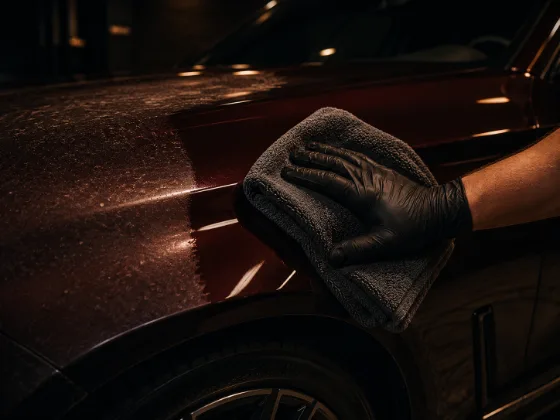
No-rinse washing has been around for decades but only recently started getting mainstream attention. The concept sounds almost too good to be true: wash your entire car with a gallon or two of water, no hose required, and end up with clean paint and no water spots.
It's not magic. It's chemistry. And when you understand how it works and when to use it, it becomes one of the most useful tools in your detailing arsenal.
What No-Rinse Wash Actually Is
A no-rinse (ONR) product is a polymer-based wash solution that you dilute heavily — typically something like 1 to 2 ounces per gallon of water — and use to wash the car panel by panel without a hose or a full rinse cycle.
The key ingredient is a synthetic polymer. When you apply the diluted solution to the paint, those polymers surround and encapsulate dirt and dust particles. The encapsulated dirt then releases from the paint surface onto your microfiber towel instead of grinding against the clear coat. When you pick up your towel, you're picking up the encapsulated dirt with it.
No water pressure is used to rinse contamination off the car. No rinse is needed after washing because the solution itself doesn't leave a film or residue that requires removal. The polymer solution does the cleaning and the lubrication simultaneously.
How It Compares to Traditional Washing
In a traditional wash, water pressure does a lot of the heavy lifting. Pre-rinsing with a hose knocks off bulk contamination before contact. A foam pre-wash or rinse-off soap further loosens dirt. Then a water-lubricated mitt moves the remaining contamination off the paint, and a final rinse removes everything.
No-rinse washing skips all of that. There's no pre-rinse, no post-rinse, no hose at all. The polymer solution replaces water pressure and soap foam simultaneously. The result is a car that looks clean, but the process is fundamentally different.
This matters because the two processes work best in different situations. Traditional washing handles heavy contamination better because you have water pressure assisting with removal. No-rinse works best when contamination levels are light and you need to wash efficiently with minimal water.
When No-Rinse Makes Sense
Apartment or condo living. If you don't have access to a hose and outdoor spigot, no-rinse washing is your most practical option for regular maintenance washing. A gallon jug or a small bucket in your trunk is all you need. Some people do their entire wash routine in a parking garage.
Water restrictions. Drought conditions or HOA rules can limit or prohibit hosing down a car. No-rinse lets you stay compliant without abandoning proper car care. Some municipalities explicitly permit no-rinse washing even when conventional washing is banned because the water usage is so minimal.
Winter washing. Washing a car in freezing temperatures with a hose is miserable and can freeze door seals and locks. No-rinse washing in a heated garage with a couple of buckets is a practical way to remove road salt without the risks that come with a full wet wash in cold weather.
Lightly contaminated cars. If the car has a layer of dust, light pollen, and maybe some light road film — but no mud, heavy grime, or caked-on contamination — no-rinse can clean it safely and quickly. This is the sweet spot for the technique.
Maintaining between full washes. If you washed the car two days ago and it's dusty but not dirty, a no-rinse wash is faster and lower-friction than pulling out the hose and going through the full process.
When NOT to Use No-Rinse
No-rinse washing has real limitations, and ignoring them is how you end up scratching your paint.
Heavily soiled cars. If the car is genuinely dirty — caked mud, heavy road grime, thick road film — no-rinse doesn't have the mechanical action or the chemical power to safely remove that contamination. You'll be wiping heavy contamination across the paint with a microfiber, which is exactly what you don't want to do. This is when you need a hose and a proper pre-rinse.
Mud. Never no-rinse wash a muddy car. Mud contains abrasive particles that need to be pressure-rinsed off the paint before any contact. Even the gentlest wiping motion on a muddy surface will scratch.
Bird droppings and bug splatter that haven't been pre-treated. Fresh or dried bird droppings and bug splatter are acidic and often contain grit. They need to be softened — not wiped across the paint. If you've got localized contamination like this, target it with a specific cleaner and let it dwell before attempting removal. A no-rinse wash solution isn't designed to break this down safely.
Cars that haven't been washed in a long time. If the car has months of accumulated contamination, it needs a full decontamination wash — pre-wash, contact wash with a mitt, full rinse — not a no-rinse approach. The contamination load is simply too high for the encapsulation polymers to handle safely.
How to Do It Without Scratching the Paint
Technique is everything with no-rinse washing because you're doing the entire job with a damp microfiber and a polymer solution — no water pressure to help you.
Use multiple microfibers. This is the most important rule. Have at least six to eight clean, high-quality microfibers ready before you start. Each microfiber is used on one panel — or sometimes half a panel on a larger vehicle — and then set aside. You never go back to a microfiber that's already been used. This prevents you from wiping contamination from one panel onto another.
Work panel by panel. Don't spray the whole car at once. Spray the solution onto one panel, work it in gently, and dry it with a fresh microfiber before moving to the next. This gives you control and ensures you're not letting the solution dry on the paint.
Spray the towel, not just the panel. Many experienced no-rinse users spray both the panel and the microfiber before making contact. The extra lubrication reduces the chance of any surface grit causing scratches.
Use overlapping, straight-line motions. No circular wiping. Straight lines, light pressure. If you feel any resistance — any grittiness — stop immediately. That resistance is grit, and pressing through it will scratch the paint.
Flip the microfiber frequently. Even within a single panel, flip to a fresh side after a few passes. Microfibers have four usable sides when properly folded. Once all four sides are used, that microfiber is done and gets set aside for washing.
Work top to bottom. Roof first, then windows, hood, trunk, and finally the lower panels and sills. Lower panels are typically the most contaminated, and you don't want to bring contamination from there to cleaner upper surfaces.
How Much Water Do You Actually Need
The math here is part of what makes no-rinse washing attractive. A typical no-rinse product mixes at around one to two ounces per gallon of water. For an average sedan, you'll use one to two gallons of solution for the entire car — sometimes a little more for larger vehicles or if you're also doing wheels and jambs.
Compare that to a traditional wash with a hose, which uses somewhere between 20 and 100 gallons depending on how long you run it. No-rinse isn't just convenient — it's a legitimately significant reduction in water usage.
For most no-rinse washes, one gallon is enough. Mix it in a spray bottle (easier for targeted application) or a dedicated bucket with a stack of folded microfibers soaking in the solution. Both methods work; the spray bottle gives you more control per panel.
Cost and Time Compared to a Full Wash
No-rinse products are concentrated, so a bottle that looks small actually goes a long way. When you factor in that you're using less than two gallons of solution per wash versus running a hose for 30 minutes, the per-wash cost of a no-rinse product is competitive with or better than traditional shampoo.
Time-wise, an experienced no-rinse washer can clean a sedan in 20 to 30 minutes — faster than a full hose wash because you're skipping the pre-rinse and post-rinse steps. The tradeoff is that you need to be more deliberate and controlled with each panel because you don't have water pressure bailing you out.
For many situations — maintenance washes on a lightly dirty car, quick cleaning before an event, winter garage washing — no-rinse is simply the better choice. Not because it's always faster or always cheaper, but because it's the right tool for those specific conditions.
What No-Rinse Won't Replace
No-rinse washing is a maintenance tool, not a substitute for a full decontamination wash. Periodically your car needs iron remover, clay bar, and a thorough traditional wash to remove contamination that accumulates beneath the surface and bonds to the clear coat in ways that encapsulation polymers can't address.
Think of no-rinse as the frequent maintenance wash between proper decontamination sessions. It keeps the car clean day to day while protecting paint by minimizing the number of times you're running a hose and a mitt across it under heavy contamination conditions.
When you do run a traditional wash, your car will be cleaner going into it because you've been maintaining it with no-rinse between sessions. Less contamination at wash time means a safer traditional wash — which means the full cycle of care works better overall.