Black is the most popular car color in the world and the hardest one to keep looking good. That's not a coincidence — black cars look stunning when perfect, so people keep buying them. What they don't realize until later is that "looking perfect" requires a completely different level of care than any other color.
If you own a black car and you're frustrated by how quickly it looks dirty or scratched, this guide is for you. The good news: there's nothing magical about caring for black paint. The bad news: every shortcut you take will show.
Why Black Is So Unforgiving
Black paint doesn't hide anything. On a silver or white car, a light swirl mark or a fine water spot disappears in the surrounding brightness. On black paint, every imperfection creates a contrast against the dark background. That's physics — light reflects differently off a damaged surface than off a perfect one, and your eye catches that contrast instantly.
Swirl marks show as a haze or a web pattern, most visible when light hits the paint at an angle. Water spots etch into the clear coat as mineral deposits and create dull, hazy rings. Dust sitting on black paint creates a gray film that makes the car look dingy within a day of washing. Even fine scratches from something as innocent as wiping off a bird dropping with a dry cloth show up on black like someone dragged a key across it.
None of this is a reason to avoid black. It's a reason to wash it correctly.
The Wash Process Matters More on Black
On a red or silver car, a slightly sloppy wash technique is mostly invisible. On black, your wash process is everything. The same wash that leaves a light-colored car looking fine will leave a black car looking like it's been sanded.
The two areas where technique matters most: how you contact the paint and how you dry it. Both are opportunities to introduce swirls if you're careless — and on black, every swirl counts.
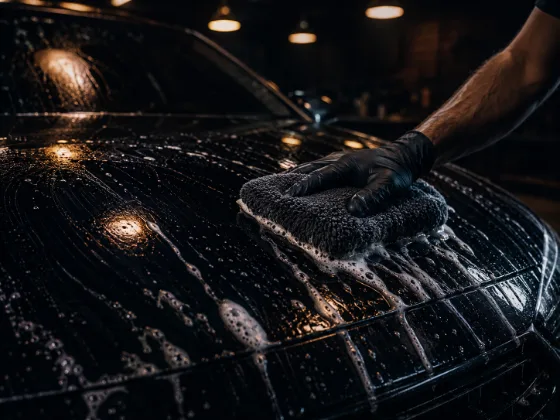
Before you touch the paint with anything, rinse the car thoroughly with a strong stream of water. You're trying to knock off as much loose contamination as possible before any contact. If you have a foam cannon, a pre-wash foam pass is even better — it softens and lifts surface grime chemically before the mitt ever touches the car. Less contamination on the paint at contact time equals fewer scratches.
Two Buckets Are Non-Negotiable
If you're washing a black car with one bucket, you are scratching it every single wash. That's not an exaggeration.
Here's the problem: your wash mitt picks up grit and road film from the paint. When you dip that mitt back into a single bucket of soapy water, you deposit that grit into the bucket. Now your "clean" soapy water is a suspension of fine abrasive particles. The next time you load the mitt, you're loading it with grit. Then you drag that grit across black paint.
Two buckets break this cycle. One bucket holds your shampoo solution and stays as clean as possible throughout the wash. The other bucket holds plain water and is where you rinse the mitt after every single panel — before it goes back to the soap bucket. Add a grit guard (a plastic grid insert) to the bottom of both buckets and you've got an extremely effective contamination management system.
The sequence: load from the soap bucket, wash one panel, rinse the mitt thoroughly in the rinse bucket, wring it out, load from the soap bucket again, wash the next panel. Never skip the rinse step. On black paint especially, this discipline is what separates a safe wash from a damaging one.
Microfiber Quality Is Make or Break
Not all microfiber is the same, and on black paint the difference matters enormously. A cheap microfiber mitt or drying towel can be scratchy, have inconsistent fiber quality, or hold grit in a way that causes it to drag against the paint rather than lift away from it.
Look for high-quality microfiber wash mitts with long, thick pile — the kind that holds a lot of water and traps dirt in the fiber rather than pressing it against the paint. Quality drying towels should be similarly dense and fluffy, not thin and flat.
Before using any microfiber on black paint for the first time, wash it. New microfiber can have loose fibers and manufacturing residue that will scratch. Wash your microfibers regularly, without fabric softener (softener clogs the fibers and reduces their effectiveness), and inspect them frequently. A compromised mitt or towel is worse than no mitt or towel — retire it immediately.
Drying Is Where Most People Mess Up
You can wash a black car perfectly and then undo all of it in the drying step. The mistake nearly everyone makes: dragging a towel across the paint.
Dragging a towel — even a clean, quality microfiber — pulls any remaining particles along the surface. On black paint, this is how you create fine scratches even after a flawless wash.
The correct technique is to pat or blot rather than drag. Lay the towel on a wet panel, press it gently, and lift it off. Let it absorb the water rather than pushing it around. For flat surfaces like hoods and roofs, fold the towel and lay it flat, press, lift, move to the next section.
Even better: a leaf blower or dedicated car dryer. Blowing water off the paint completely eliminates contact during drying. Water spots can still form if you don't remove water before it evaporates, but you get there without touching the paint at all. Many serious enthusiasts with black cars dry them entirely by air and only use a towel to get the last moisture out of panel gaps and mirrors.
If you do use a towel, use a drying aid — a quick detailer or dedicated drying spray misted onto the wet paint before the towel touches it. This adds lubrication between the towel and the paint, reducing the friction that causes scratches.
The Light Test
After washing and drying, do the light test before you call the job done. The idea is simple: inspect the paint in direct sunlight or under a bright artificial light at an oblique angle — light coming across the surface rather than straight at it.
Oblique light makes swirls and scratches visible in a way that diffuse overhead light doesn't. Walk around the car slowly, looking at each panel from multiple angles. Water spots show up as cloudy rings. Swirls show up as a hazy web. If you see something you didn't see before, you now know — and you can decide whether it requires attention or whether it's within acceptable limits for daily-driver use.
The light test is also how you check your wash process. If you're seeing new swirls after every wash, something in your technique or your tools is causing damage. Use the light test to identify the problem early, before months of scratching pile up.
Between Washes: Never Dry-Wipe
Black cars attract dust visibly. Between washes, the temptation is to grab a cloth and wipe off the surface dust. Resist this completely.
Wiping dry dust off black paint with any cloth — even a clean microfiber — drags those particles across the clear coat. You're effectively sanding the paint. This is how black cars develop swirl marks from seemingly gentle handling.
For light dust between washes, use a quick detailer spray. Mist it onto a panel, then use a clean, soft microfiber to gently lift — not wipe — the dust away. The spray lubricates the surface so the particles can be picked up rather than dragged. Work panel by panel, use a fresh side of the microfiber for each panel, and never use a cloth that's been sitting in a garage where it could have picked up grit.
For slightly heavier contamination that doesn't warrant a full wash, a waterless wash product gives you more cleaning power than a quick detailer while still encapsulating dirt safely. Same technique: spray, gently lift, fresh microfiber side for each panel.
Realistic Expectations for Daily Drivers
Here's the truth that nobody likes to hear: a black daily-driver car will never be 100% swirl-free. You can minimize swirls dramatically with proper technique, but daily driving means parking lots, car washes you didn't choose, gas station attendants wiping the windshield, bugs, bird droppings wiped off in a hurry, and a hundred other small insults to the paint.
The goal isn't perfection. The goal is managing degradation so that the car stays looking good in normal lighting and doesn't require machine polishing every few months. With consistent, correct washing technique you can keep a black car looking genuinely sharp for years.
When swirls do accumulate to a point where they bother you, a light polish or one-step paint correction can remove them — and then you start the cycle again with clean paint and correct habits. Think of it as maintenance, not failure.
Protection Matters More on Black
A protective layer on black paint does two things: it makes contamination easier to wash off (so you're dragging less grit during the wash) and it adds a small buffer between the paint and whatever contacts it.
Wax, paint sealant, or ceramic coating all provide this protection at different levels of durability. Whatever you use, keeping a protective layer on black paint is more important than on lighter colors because the same amount of wear shows up so much more visibly.
Apply protection more frequently on a black car than you might think necessary. When water stops beading off the surface and starts sheeting or sticking, your protection is gone and the paint is more vulnerable to water spotting and contamination bonding.
The Short Version
Two-bucket wash with high-quality microfiber. Rinse the mitt after every panel without fail. Pat dry rather than drag, or use an air dryer. Spray detailer for touch-ups between washes — never dry-wipe. Do the light test so you know where you stand. Keep protection on the paint at all times.
Black is high-maintenance. But "high-maintenance" just means it requires consistency, not complexity. Get the process right and keep it consistent, and a black car rewards you with a depth of color and gloss that no other paint can match.