
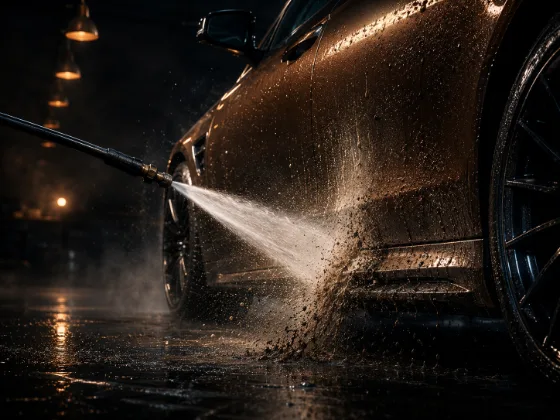
Pressure washers are one of the more polarizing purchases in the detailing community. Some detailers use them for every wash. Some do everything with a hose. Most people considering one are somewhere in between — wondering if they're missing out, or wondering if the one they already own is appropriate for the job.
Here's a straightforward breakdown: what a pressure washer does in detailing, what specs matter, and where the common mistakes are.
What a Pressure Washer Actually Contributes to Detailing
A pressure washer amplifies water flow with concentrated high pressure. For detailing, it contributes in three specific ways:
Pre-rinse and pre-soak: A strong rinse before washing loosens and removes loose contamination — road grit, mud, heavy dust — before you touch the paint with a mitt. This is the most important function. The more loose contamination you remove before contact washing, the less there is to grind across the paint surface. A pressure washer does this faster and more thoroughly than a garden hose.
Foam cannon use: Foam cannons — the devices that produce thick shaving-cream-like foam on the car's surface — require a pressure washer to function. They dilute car shampoo and inject it into the pressure washer's water stream, aerating the mix to create foam. Without a pressure washer, a foam cannon is a very expensive piece of plastic. If foam cannons are part of your workflow, a pressure washer is required.
Post-wash rinse and engine bay cleaning: A targeted, high-pressure rinse after washing rinses shampoo from panel gaps, door jambs, and difficult-to-reach areas more effectively than a garden hose. And for engine bay cleaning or wheel arch cleaning, the pressure is genuinely useful for removing embedded grime that a hose won't budge.
What a pressure washer does not do: correct paint, remove bonded contamination (iron remover and clay bar do that), or replace the contact wash step. Even with a foam cannon pre-soak, you still need to wash with a mitt. The pressure wash is the setup, not the job.
PSI and GPM: The Two Numbers That Matter
Every pressure washer has two key specifications: PSI (pounds per square inch) and GPM (gallons per minute). Understanding both is critical.
PSI is the pressure of the water stream — how much force it delivers to the surface. Higher PSI = more pressure.
GPM is the volume of water flowing through the machine. Higher GPM = more water per minute.
The cleaning power of a pressure washer is roughly the product of these two numbers: PSI × GPM = cleaning units (sometimes listed as "cleaning units" or CU in spec sheets). A 2000 PSI / 1.6 GPM machine and a 1600 PSI / 2.0 GPM machine have similar cleaning power but deliver it differently. The higher-PSI machine has a more intense, concentrated stream. The higher-GPM machine moves more water, which is more effective for rinsing wide surfaces quickly.
For car washing: too much PSI is a problem. High pressure at close range can lift clear coat edges, force water into sealed gaps, damage rubber seals and trim, and strip wax or sealant from the paint. The recommended PSI range for paint-safe car washing is 1200–2000 PSI, used with a wide-fan nozzle (25° or 40°) at appropriate distance from the paint (typically 18"–24" minimum on the paint surface).
GPM affects how fast you can work — higher GPM means faster rinsing. For a home detail setup, 1.5–2.0 GPM is entirely adequate. Higher GPM becomes more relevant if you're rinsing a very large vehicle or working at a commercial pace.
Electric vs. Gas Pressure Washers
Electric pressure washers are the right choice for almost all home detailers. They're quieter, require no fuel or oil maintenance, are lighter and easier to store, start reliably, and are available in the PSI range appropriate for car washing (1200–2200 PSI). They plug into a standard 110V outlet. The main limitation is that they typically max out around 2000–2200 PSI and 1.5–2.0 GPM — which is perfectly adequate for detailing and won't damage paint if used correctly.
Gas pressure washers start at the pressure range where you need to be careful on paint. Most home gas units produce 2500–3500 PSI or more. At those pressures, you're genuinely at risk of paint damage if you get the nozzle too close, if the angle is wrong, or if you use a narrow-fan nozzle. Gas washers are for cleaning concrete, decks, siding, and heavy equipment — not for routine car washing. The additional maintenance (oil, fuel stabilizer, winterization) and the noise make them a poor fit for detailing use even if you're careful about pressure.
If you already own a gas pressure washer: you can use it on your car safely if you use a wide 40° nozzle, stay 24"+ from the paint, avoid spraying directly at trim gaps and rubber seals, and don't linger in one spot. But it's not the ideal tool and the margin for error is smaller.
What to Look for in a Detailing-Appropriate Electric Pressure Washer
1500–2000 PSI: The right pressure range for car washing. Enough to remove stuck-on mud and road grime, suitable for foam cannon use, and paint-safe with appropriate nozzles and distance. Don't chase maximum PSI — it's not a benefit for this application.
1.5 GPM or better: Adequate for home use. Some budget units are 1.2 GPM or less, which is functional but slower to rinse and may not produce adequate foam cannon output.
Adjustable pressure or nozzle set: Variable pressure is convenient. More commonly, pressure washers include a nozzle set — different colored nozzles that produce different fan angles and pressures. For car washing, you'll primarily use the 25° (green) nozzle for general rinsing and the 40° (white) nozzle for the paint surface. The 0° red nozzle (point jet) should never be used on a car. A soap/detergent nozzle (black) is typically included for foam soap application without a foam cannon.
M22 or standard connection for foam cannon compatibility: If you plan to use a foam cannon, verify the pressure washer's output connection is compatible with the foam cannon you want. M22 is the most common connection thread. Some machines use different proprietary fittings that limit accessory compatibility.
Hose length: At minimum 20 feet of hose lets you work around a car without moving the unit. 25–30 feet is better, particularly on larger vehicles or trucks.
Brands and Budget
Under $150: Sun Joe, Westinghouse, and Ryobi entry-level electrics. These are functional for car washing but build quality is variable. Motors tend to be louder and run hotter. GPM is often lower (1.2–1.4 GPM). Adequate for occasional home use, but may not hold up to heavy regular use. Compatible with most foam cannons.
$150–$300: Better Ryobi, Greenworks, and Karcher models. Better motor construction, higher GPM, more durable fittings and hose connections. Karcher in particular has an excellent reputation for build quality at this price range. The Karcher K5 and equivalent models are what many serious home detailers use.
$300–$500: Semi-professional electric machines from Karcher, Simpson, and Mi-T-M. More durable pumps, better thermal protection, commercial-grade connectors. The right choice if you're using the machine regularly — several times per week — or detail for others.
What's Actually Overkill
Spending $800+ on a commercial pressure washer for car washing at home is overkill. Chasing maximum PSI is overkill — anything over 2000 PSI is higher than you need and increases the risk of paint damage. The hot water pressure washers used in commercial detailing settings are impressive but require plumbing, 240V power, and maintenance beyond what a home setup warrants.
For most home detailers, a $200–$250 electric pressure washer is the right call — enough pressure for foam cannons and effective pre-rinse, durable enough to last years with regular use, and genuinely safer on your paint than either a cheap unit with variable pressure or a commercial gas machine.
Do You Actually Need One?
Honest answer: you can do excellent detailing without a pressure washer. A garden hose with a decent nozzle delivers enough water flow for pre-rinsing. You lose the foam cannon capability and the power to dislodge stuck mud from wheel arches, but those are convenience improvements, not requirements for quality results. If you're washing your car every few weeks on reasonably clean paint, a garden hose and two-bucket wash produce the same quality outcome as a pressure washer setup.
Where a pressure washer pays for itself: if you detail multiple vehicles, deal with vehicles that get significantly dirty (off-road use, muddy conditions), or want to use a foam cannon as a pre-wash step. The pre-rinse quality improvement and the foam cannon capability are the genuine value propositions — not raw cleaning power, which is more a function of your contact wash than of water pressure.