
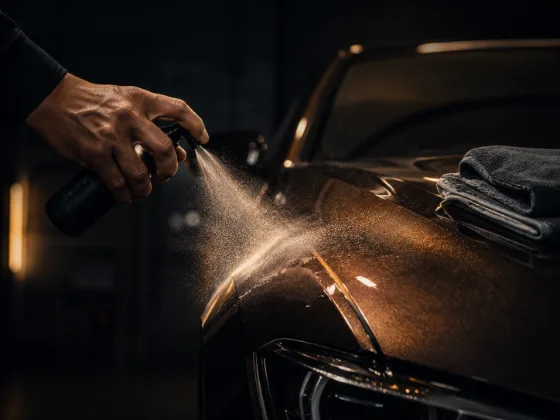
Spray ceramic coatings are one of the most popular new categories in consumer detailing. They promise the benefits of a traditional ceramic coating — durability, hydrophobicity, protection — without the preparation requirements, the application difficulty, or the cost of a professional installation.
Some of that promise is real. Some of it is marketing. The honest answer to "is a spray ceramic worth it?" is: it depends what you're comparing it to.
What Is a Spray Ceramic Coating?
Traditional ceramic coatings are high-concentration SiO2 (silicon dioxide) formulas — typically 85–95% SiO2 — that require extensive surface preparation (full decontamination, paint correction), careful application, and a cure window of 12–24+ hours. They form a genuine semi-permanent bond with the clear coat that can last 2–5 years.
Spray ceramics are diluted versions of this chemistry — typically 3–15% SiO2 in a spray carrier, sometimes blended with polymer sealant chemistry. They can be applied in minutes without extensive prep, don't require a precise cure window, and are much more forgiving to use. The trade-off is that the bond they form is significantly weaker and the durability is much shorter.
What Spray Ceramics Actually Deliver
Real hydrophobic protection. Even at lower SiO2 concentrations, spray ceramics produce genuine water beading or sheeting behavior. Applied correctly on clean paint, a spray ceramic makes the car wash better, resist light contamination more effectively, and look noticeably more glossy. This isn't just wax behavior — it's actual SiO2 chemistry at work.
Better durability than spray wax or sealant. Most quality spray ceramics last 3–12 months, compared to 4–12 weeks for spray wax and 6–12 months for a traditional sealant. The better-performing spray ceramics actually compete with entry-level sealants on durability — occasionally beating them — while being faster to apply.
A meaningful protection layer. The hardness of the cured chemistry from a spray ceramic is lower than a full coating but still meaningfully protective. It provides a sacrificial layer that takes the hit from light abrasion, UV exposure, and contamination before it reaches the paint.
Easy reapplication. Because the product is spray-and-wipe, you can reapply after every wash if you want — essentially maintaining a fresh ceramic layer on the car continuously. This changes the math on durability: if you're reapplying monthly anyway, the question isn't "does it last longer than a traditional coating?" but "is the protection quality worth the 5 minutes it takes?"
What Spray Ceramics Don't Deliver
The same bond as a full ceramic coating. The molecular bond between a diluted spray ceramic and the clear coat is fundamentally weaker than a high-concentration professional coating. A proper ceramic coating forms a cross-linked matrix that integrates with the clear coat surface. A spray ceramic sits more like a durable sealant with SiO2 enhancement — better than a polymer sealant alone, but not in the same category as a true coating.
2–5 year durability. Any spray ceramic claiming multi-year durability without the prep and application protocol of a traditional coating should be viewed skeptically. Real-world durability is typically 3–12 months. Manufacturers occasionally cite lab test results under conditions that don't reflect actual vehicle use.
The ability to skip surface prep entirely. Spray ceramics apply faster and more forgiving than traditional coatings, but applying any ceramic product over contaminated or scratched paint just locks in those problems. The paint should be clean and decontaminated. Paint correction isn't required, but it's still a good idea — any swirl marks or scratches visible before application will remain visible under the ceramic.
Scratch resistance comparable to a full coating. The hardness ratings on spray ceramics don't translate to the same scratch protection as a full-thickness, fully bonded traditional ceramic. Swirl marks from improper washing technique will still happen on spray-ceramic-protected paint.
Spray Ceramic vs Traditional Ceramic: The Honest Comparison
| Spray Ceramic | Traditional Ceramic | |
|---|---|---|
| SiO2 concentration | 3–15% | 85–95% |
| Application time | 5–15 minutes | 2–8 hours |
| Prep required | Clean paint | Full decon + correction |
| Durability | 3–12 months | 2–5 years |
| Bond strength | Moderate | Very strong |
| Hydrophobicity | Good | Excellent |
| Cost | $20–60 | $50–200+ (DIY) or pro labor |
| Difficulty | Easy | Moderate–difficult |
When a Spray Ceramic Makes Sense
As a standalone product for a daily driver you don't want to invest significant time in. If you're not willing to do the prep required for a full ceramic coating, a spray ceramic is a genuinely better option than nothing — and better than spray wax alone on most metrics.
As a maintenance product on top of a full ceramic coating. This is one of the best uses. Spray ceramic applied over a fully cured traditional coating adds a fresh SiO2 layer that refreshes hydrophobicity and adds a sacrificial buffer. It costs almost nothing to apply after a wash and extends the effective life of the base coating significantly.
When you want better durability than spray wax without the complexity of a full coating. For most people who aren't willing to learn full ceramic application technique, a spray ceramic is the best durability-to-effort trade-off available.
When a Spray Ceramic Doesn't Make Sense
As a replacement for a professional ceramic coating on a car you care about long-term. If you want real, lasting protection on a valuable vehicle, a proper coating is worth the investment. A spray ceramic doesn't give you the same protection regardless of how it's marketed.
If you're not willing to wash the car properly anyway. Even the best spray ceramic applied consistently doesn't compensate for scratching the paint with dirty towels and skipping proper washing technique. Technique matters more than product.
The Bottom Line
Spray ceramics are worth it when the comparison is "spray ceramic vs. nothing" or "spray ceramic vs. spray wax." They're worth it as a maintenance boost on a traditionally coated car. They're not worth it as a replacement for a full professional ceramic coating if that's what you actually need.
Used correctly, a quality spray ceramic is one of the highest-value products in consumer detailing — more protection than wax, easier application than traditional coatings, and good enough for the majority of daily driver use cases.