You washed the car. You dried it carefully. You stand back and it still looks... off. A little hazy. A little rough. Not the glossy, deep finish you were expecting.
This is one of the most common frustrations in detailing, and the cause almost always comes down to the same thing: contamination that's bonded to the paint itself.
Washing removes loose surface dirt. Decontamination is a completely different process that removes contamination that's chemically or physically embedded in the paint. Until you do it, no amount of washing, waxing, or polishing will get your paint looking the way it should.
What Contamination Actually Is
Paint contamination isn't just dirt. Dirt washes off. Contamination is foreign material that has bonded to or embedded into the clear coat over time.
There are two main categories:
- Chemical contamination: Iron particles from brake dust and rail dust, industrial fallout, tree sap residue, water spot mineral deposits, and road tar. These particles actually embed into the surface or leave behind hard mineral deposits that washing can't break.
- Physical contamination: Fine particles of road grime, overspray, and environmental fallout that bond to the paint surface and create a rough texture. Run your fingertip across a panel on a "clean" car — if it feels like fine sandpaper instead of glass, that's physical contamination.
These two types require different removal methods, which is why decontamination is a sequence rather than a single product.
Why Washing Can't Remove It
Shampoo is designed to emulsify and lift surface-level soiling. It works by breaking the bond between loose dirt and the paint surface and holding it in suspension in the wash water.
Contamination doesn't respond to this process because it isn't loosely sitting on the surface. Iron particles can be partially melted into the clear coat by heat. Mineral deposits from water spots are crystalline structures bonded directly to the surface. Tar is a hydrocarbon resin that adheres aggressively to paint chemistry.
These materials require specific chemical actions — not just soap and water — to break down and remove. Trying to wash them off harder just means you're dragging a contaminated surface around with your mitt.
The Three Types of Decontamination
A full decontamination cycle uses three distinct approaches, each targeting a different type of contamination:
Iron remover / fallout remover: A chemical spray that reacts specifically with ferrous (iron-containing) particles on the paint surface. The chemistry is fairly dramatic — the product turns purple when it contacts iron, which tells you exactly where contamination is heaviest. After a dwell period, the reaction converts hard iron particles into a water-soluble compound that rinses off. No scrubbing required.
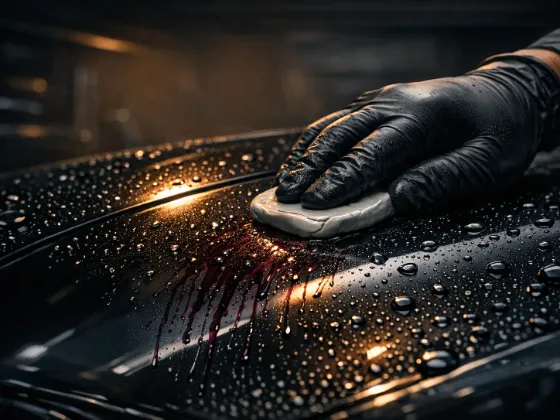
Clay bar / clay mitt: A mildly abrasive clay compound that physically shears off bonded surface contamination — industrial fallout, overspray, mineral deposits — as it's glided across a lubricated paint surface. The clay picks up what it dislodges and traps it in the clay matrix. This is what removes the rough, sandpaper texture from paint.
Tar remover / solvent-based spot treatment: Specifically targets hydrocarbon-based contamination — road tar, adhesive residue, bitumen spots. These need a solvent-based product rather than a water-based one, because water can't dissolve petroleum-based compounds.
Not every car needs all three every time, but understanding each one lets you target what's actually on your paint.
How to Know If You Need It
The simplest test is the plastic bag test. Put your hand in a clean plastic bag (or use a latex glove) and slowly drag it across a section of paint you've just washed and dried. If the paint feels perfectly smooth — glassy — the surface is relatively clean. If you feel any roughness, grittiness, or texture, that's contamination.
You can also look for visual signs:
- Small, orange-brownish specks on white or silver paint — these are iron particles
- Cloudy or hazy areas that don't clear up with washing
- Small black spots or dots on lower panels — often tar or road grime
- Hard water spots that have been on the paint for a long time and won't rinse off
If any of these are present, washing more carefully won't fix them. You need decontamination.
When Decontamination Has to Come First
If you're planning to apply a ceramic coating, paint sealant, or wax, decontamination isn't optional. It's mandatory prep.
A coating applied over contaminated paint bonds to the contamination, not the paint. That means it can lift, delaminate, or fail prematurely. Worse, it seals the contamination under a protective layer, making it harder to address later.
The same is true if you're polishing. Polishing over contamination embeds those particles in the polish and effectively uses them as an abrasive — which defeats the purpose of polishing in the first place.
Clean surface first. Everything else second. That's the principle.
How Often Does It Need Doing?
Most daily-driven cars benefit from a full decontamination once or twice a year, typically before a seasonal paint protection application. Cars that do a lot of highway miles, live near industrial areas, or park near rail lines may need it more often.
The plastic bag test is more reliable than any schedule. Do the test. If the paint feels rough, decontaminate. If it feels smooth, skip it and just wash normally.
The Payoff
A car that's been properly decontaminated feels fundamentally different from one that hasn't. The paint is smooth and glass-like under your fingertips. Light reflects evenly instead of scattering off embedded particles. Products — wax, sealant, coating — bond properly and last longer.
Decontamination is one of those steps that's easy to skip because it doesn't get a lot of attention. But it's the reason some cars always look incredible and some always look like they need more work despite constant washing. Clean the surface. Really clean it. The difference is immediately obvious.