
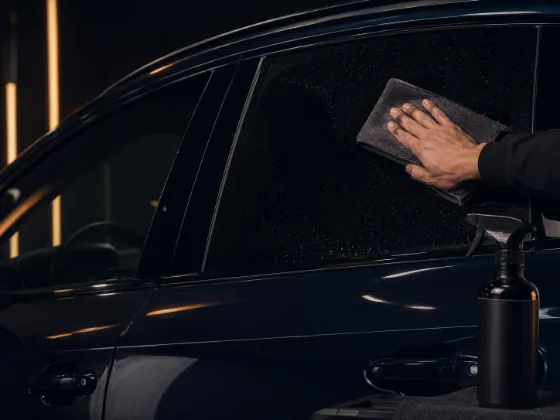
Most of the glass cleaner sold at gas stations and grocery stores contains ammonia. On bare glass, it works fine — ammonia is an excellent grease and residue cutter. On tinted windows, it's a slow-acting destroyer. The damage doesn't happen overnight, but over months and years, ammonia-based cleaners cause tint film to bubble, purple, and peel.
If your car has window tint — factory tint, aftermarket tint film, or any privacy glass film — you need to understand what's in your glass cleaner before you use it on the inside of those windows.
What Ammonia Does to Tint Film
Window tint film is a polyester film with a dye or metalite layer that provides the color and UV/heat rejection, bonded to the glass with a pressure-sensitive adhesive and coated on the interior-facing side with a scratch-resistant hard coat.
Ammonia attacks both the adhesive layer and the dye. It's a solvent that penetrates the film through microscopic imperfections and begins dissolving the adhesive bond between the film and the glass. Initially, the damage is invisible — the adhesive weakens over a large area before it becomes apparent. Then bubbles form as the adhesive lets go in isolated spots. As the damage progresses, the adhesive continues to fail, bubbles multiply, and the edges of the film begin to lift.
Simultaneously, ammonia oxidizes the dye in older dyed tint film, causing the characteristic purple discoloration you see in old tint. The original charcoal or gray color becomes purple because ammonia degrades the dye while leaving certain components intact, shifting the color of the remaining pigment.
Modern metalite (metalized) and ceramic tint films are more resistant to ammonia than older dye-based films, but even premium ceramic tint is affected over time. The adhesive degradation is the more universal problem — it happens regardless of the type of tint film.
Factory vs. Aftermarket Tint
Factory tint — the standard dark glass on rear side windows of most vehicles — is not a film. It's glass that was manufactured with tinting compounds integrated into the glass itself. Ammonia cannot damage the glass by affecting an adhesive layer because there is no adhesive layer.
If your vehicle has factory tint on the rear windows and no additional film, you can technically use ammonia-based glass cleaner on those windows. However, many vehicles have both factory tinted glass and aftermarket tint film on top of it (especially for privacy compliance), and many have aftermarket tint on the front windows even with factory tint on the rear. Unless you're certain which is which, it's simpler to use ammonia-free glass cleaner on all windows rather than risk the film.
Aftermarket tint is always a film applied to the glass surface. The identifying sign is that you can see the edge of the film if you look at the corner of the window where it meets the door seal. Factory tint has no edge — it's the glass itself.
What to Look for on a Label
The ingredient list on glass cleaner bottles is often incomplete, but here's what to look for:
Ammonia appears as "ammonia," "ammonium hydroxide," or with the chemical notation NH3. Any of these means avoid it on tint film.
Ammonia-free glass cleaners use alternative grease cutters — typically isopropyl alcohol, ethanol, or specific surfactant blends. These are effective on glass film without the adhesive-degrading chemistry.
Products marketed specifically as "tint-safe" or "ammonia-free" are safe by design. The designation exists because tinted windows are common enough that manufacturers have a market for compliant formulas.
If you're not sure, spray a small amount on a paper towel and smell it. Ammonia has a sharp, pungent odor that's hard to mistake. If it smells like standard window cleaner, assume it contains ammonia unless the label says otherwise.
Rubbing Alcohol as a Glass Cleaner
Isopropyl alcohol (70% or higher) is an effective, tint-safe glass cleaner that most people have in the house. It cuts through the outgassing film that builds up on interior glass, dries quickly without streaking, and has no effect on tint film adhesive. It's not formulated specifically for glass — it lacks the surfactant blend that helps with water spots and exterior contamination — but for interior glass on tinted windows, it's a reliable option.
Apply to a microfiber towel, not the glass directly. Use the two-towel method: one damp towel to clean, one dry towel to buff. Alcohol evaporates faster than glass cleaner, so work in small sections to avoid it drying before you can buff.
What About the Outside of Tinted Windows?
Tint film is applied to the inside surface of the glass. The outside surface of a tinted window is bare glass with no film. Technically, ammonia-based cleaner on the outside won't affect the tint film directly.
In practice, ammonia-free cleaner is still the better choice for all window surfaces. The risk of product overspray or runoff reaching the edge of the door seal and wicking to the inside surface is real, especially when windows are partially open or the door seal is slightly degraded. Using ammonia-free on all exterior windows eliminates this risk. It also simplifies your process — one product for all glass rather than two different cleaners depending on which surface you're cleaning.
Tint Longevity and Cleaning Frequency
Window tint film that's cleaned only with ammonia-free products lasts significantly longer than tint cleaned with ammonia-based products. Professional tint installations often come with a warranty specifying ammonia-free glass cleaners — not as a sales tactic, but because the shops see what happens to tint treated with the wrong products.
Good-quality aftermarket tint, properly maintained, should last 10–15 years before the adhesive begins to age naturally. Tint that's been regularly cleaned with ammonia-based products typically shows bubbling and purpling in 3–5 years, sometimes less in hot climates where the film is already under more thermal stress.
The switch to ammonia-free glass cleaner is a minor change that costs nothing extra — ammonia-free formulas are widely available at the same price points as standard window cleaner. The difference in tint longevity makes it one of the simplest maintenance decisions with a clear payoff.