
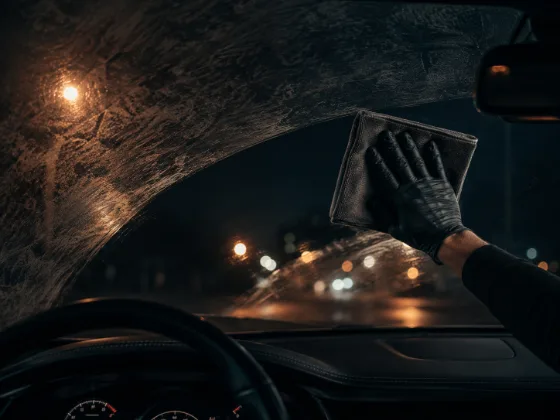
You clean your windshield. Two weeks later, that familiar haze is back — that greasy, blurring film that makes night driving uncomfortable and headlights bloom into glare. It doesn't matter how many times you wipe it. It keeps coming back.
This isn't a product failure. It's a chemistry problem with a specific cause, and once you understand it, you can clean it correctly and keep it from returning as fast.
What the Film Actually Is
The film is mostly outgassing residue — volatile organic compounds (VOCs) released from interior materials as they off-gas. Vinyl dashboards, plastic trim pieces, adhesives used in headliners and door panels, rubber seals, seat foam, and carpet backing all release these compounds slowly over time. The compounds are gaseous at interior temperatures, circulate in the enclosed cabin air, and then condense on the coolest surface available — the glass.
The windshield is typically one of the cooler surfaces in the car interior because it's in contact with outside air on one side. So the condensing VOCs preferentially deposit on glass rather than on the dash or door panels. New cars off-gas heavily (that "new car smell" is largely VOCs evaporating), which is why film buildup is fastest in the first year or two. Older cars still off-gas, just at a slower rate.
A secondary contributor is tobacco smoke if anyone smokes in the car. Smoke particles and residue accelerate the film formation significantly and add a nicotine-and-tar component that's significantly harder to cut than plain outgassing residue.
Cooking smells, food odors, and pet dander also contribute, but outgassing is the primary driver in most cars.
Why It's Harder to Remove Than It Looks
The film feels like it should wipe right off — it's on the surface of glass, after all. But it's not a water-soluble layer. It's oily and lightly adhesive, and a dry wipe or a water-based cleaner doesn't cut through it effectively. You need a glass cleaner with a degreasing component.
The other challenge is pressure and geometry. The inside of a windshield is at a steep angle, the surface area is large, and accessing the center and lower corners requires awkward reach. It's easy to clean the driver's side and the areas near the edges where you can reach easily, and then leave the center of the windshield — the area that matters most for forward visibility — still hazy.
And because the film is oily, a glass cleaner applied with inadequate pressure just redistributes it. You end up with a more uniformly distributed film that looks like streaks, and you conclude that the cleaner didn't work. The cleaner wasn't the problem. Pressure and coverage were.
How to Remove It
You need three things: a glass cleaner that can cut oil-based contamination, a tool that lets you apply proper pressure across the full windshield surface, and a two-towel technique.
The tool problem. Trying to clean the inside of a windshield with a handheld microfiber towel alone is fighting the geometry. Your wrist bends uncomfortably, you can't generate even pressure, and you'll inevitably miss the center. An interior windshield cleaning tool — a microfiber pad on a pivoting handle, often called a "windshield wizard" style tool — solves this. The pad reaches the center of the windshield with proper pressure, and the pivot lets the pad stay flat against the angled glass as you move across the surface.
The process.
Start with a dry microfiber wipe first. Before applying any cleaner, do a dry pass with a clean microfiber cloth across the entire interior windshield. This removes loose dust and surface contamination. Cleaning a dusty surface with glass cleaner turns the dust into a thin paste that streaks — the dry pass eliminates this problem.
Apply glass cleaner to your cleaning pad or cloth, not to the glass. Spraying directly onto the glass causes product to run down into the dash, onto the vent surfaces, and potentially into the defrost grid if your windshield has it. Loading the pad gives you control over coverage.
Work in overlapping vertical strokes, then horizontal strokes. Cover the entire surface. Apply firm pressure — more than you think is necessary. The oily film needs to be broken and lifted, not just moistened. A single light pass won't do it.
Immediately follow with a clean, dry glass microfiber towel — a fresh one, not the one you used for the dry pre-wipe. Buff in the opposite direction you cleaned. This picks up the dissolved film and any remaining product. Inspect at multiple angles.
For severe film — heavy smoker's cars, cars that sat in heat for a long time — you may need two cleaning passes. Let the first pass dry completely, then repeat.
Why It Comes Back
The film comes back because the source (outgassing interior materials) hasn't changed. The rate at which it comes back depends on:
Temperature. Hot interiors accelerate outgassing dramatically. A car that sits in direct sun all day generates significantly more VOC residue than a car kept in a garage. This is why film buildup is fastest in summer and in sunnier climates.
New vs. old interior. New cars off-gas more than old ones. If you have a new car or recently replaced interior components (new seat covers, a new headliner, new carpet), expect faster film buildup for the first 6–12 months.
Cleaning frequency. The thicker the film gets, the more it affects visibility and the harder it is to clean. A light film cleaned monthly is easier to address than a six-month accumulation.
Practical Maintenance Schedule
For most cars, cleaning the interior windshield once a month is enough to prevent the film from reaching the visibility-affecting stage. Twice a month in summer or if the car sits in direct sun.
The front passenger's window and rear window also accumulate the film, though the problem is usually most noticeable on the windshield because of its size and the angle at which you look through it while driving. Include all interior glass in your routine, not just the windshield.
Night Driving as a Test
The best way to tell if your interior windshield glass is actually clean is to drive at night with oncoming headlights. A hazy windshield turns oncoming headlights into a starburst glare pattern — the light scatters off the surface contamination. A clean windshield passes the headlight through clearly without significant bloom.
If you've ever driven at night and thought "these headlights are terrible" — there's a reasonable chance your windshield is what's terrible, not the lights. Clean the interior glass and compare.