
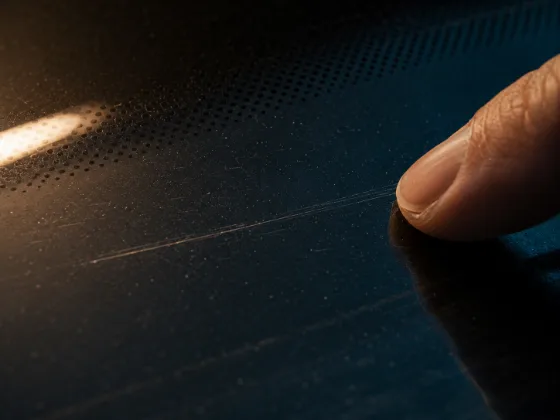
You've got a scratch in your windshield. Maybe it came from a wiper blade with a piece of grit embedded in it. Maybe from cleaning the glass with an abrasive. Maybe you have no idea. The question now is whether this scratch is in the glass itself or in a coating on top of the glass — because the answer determines whether it's fixable in your driveway or whether you're looking at a windshield replacement.
What Might Be on Top of Your Glass
Modern windshields can have several layers applied on top of the bare glass surface:
Factory rain-sensing coating. Some vehicles have a hydrophilic or hydrophobic treatment applied at the factory to the outer surface of the windshield, often in the area behind the rearview mirror where the rain sensor reads water on the glass. This is a thin factory coating that can be scratched or abraded.
Aftermarket rain-repellent coating. Products like RainX, glass sealants, and similar hydrophobic treatments create a thin layer on the glass surface that causes water to bead and sheet. These are applied coatings that sit on top of the glass — they can be scratched, and those scratches are in the coating, not the glass.
Ceramic glass coating. A more durable glass coating applied by detailers or DIYers to provide hydrophobic properties and some scratch resistance. Ceramic coatings on glass are harder than most rain-repellent products but they can still be scratched by abrasive cleaning, hard debris, or a deteriorated wiper blade.
Bare glass with nothing on it. Many cars have no coating on the glass whatsoever. In this case, any scratch you see is in the glass itself.
The Fingernail Test
The first diagnostic is tactile, not visual. Run your fingernail gently across the scratch in the direction perpendicular to the scratch line. You're feeling for whether your nail catches and drops into the scratch.
If your fingernail catches noticeably, the scratch has depth — it has displaced or removed material enough to create a detectable edge. This indicates a real scratch in the glass or in a relatively thick coating, and it's less likely to be something that polishes out easily.
If your fingernail glides across the scratch without catching, the scratch is superficial — it's surface-level marking rather than material removal. Scratches that pass the fingernail test without catching are almost always in a coating or in the very topmost surface of the glass, and they often respond to polishing.
This test isn't definitive — some genuine glass scratches are fine enough to not catch a fingernail — but it's a useful first filter.
The Water Test
If there's a coating on your glass, the coating has different optical properties than the underlying bare glass. Wetting the scratched area can reveal this.
Apply a small amount of water or glass cleaner to the scratch. Look at the scratch wet, then let it dry and look at it dry. If the scratch is more visible when dry and nearly disappears when wet, the scratch is likely shallow and surface-level — water temporarily fills and masks the scratch in the same way it would on a shallow mark in any smooth surface. Scratches in bare glass also disappear when wet to some extent, but the effect is more dramatic with surface-level coating scratches.
The other thing water reveals: if the scratch area doesn't bead water the way the rest of the glass does (assuming you have a rain-repellent coating), the coating has been removed in that spot, confirming the scratch is at least coating-deep.
Look at the Scratch in Raking Light
Shine a bright light — a flashlight or your phone's flashlight works well — at a very low angle across the scratch (raking light, nearly parallel to the glass surface). In this lighting, coatings show a slightly different surface texture than bare glass because they have a different surface topology. The scratch will typically look different depending on whether you're looking at a coating scratch vs. a glass scratch.
A coating scratch in raking light often looks like a bright white line with slightly fuzzy edges — the coating material has been disturbed and scattered on either side of the scratch path. A glass scratch often looks like a bright, crisp line with hard edges — actual glass material has been removed or fractured.
This is less a definitive test and more additional information that, combined with the fingernail test and water test, gives you a clearer picture.
The Polish Test
If you have any doubts after the tests above, the most conclusive diagnostic is a small polish test. Apply a small amount of glass polish or very light compound to the scratch area and work it in with a microfiber cloth or a foam pad. Then clean the area and evaluate.
If the scratch improved or disappeared, it was in a coating or in the very top surface of the glass — polishing removed the damaged material or leveled the surface enough to eliminate the visible scratch.
If the scratch didn't change, it's in the glass itself and will require either glass scratch repair (which is a specialized process using glass polishing compounds significantly more aggressive than paint correction products) or replacement.
Start with a lighter polish rather than jumping straight to an aggressive compound. If a light polish shows improvement, you may not need anything more aggressive.
When It's Actually in the Glass
Glass scratches — actual damage to the glass substrate rather than a coating — are significantly harder to address. Glass is much harder than clear coat on paint and requires specialized abrasives to polish. The process generates heat, requires water cooling, and is time-consuming.
Deep glass scratches — ones that catch the fingernail noticeably and didn't respond to polishing — generally fall into two categories. Scratches that don't affect your line of sight are a cosmetic issue and a judgment call about whether to repair or leave them. Scratches that are in the driver's direct field of vision are a safety issue, particularly because glass scratches scatter light in the same way that interior film does — making them much more problematic at night with oncoming headlights.
For safety-critical scratches in the driver's field of view, windshield replacement is usually the right answer rather than attempting glass scratch repair.
Wiper Blade Maintenance as Prevention
The majority of windshield glass scratches come from deteriorated wiper blades. The rubber squeegee on a wiper blade is designed to glide across glass without contact between the metal frame and the glass surface. When the rubber deteriorates — cracking, tearing, or becoming rigid — the metal components of the blade can make contact with the glass. In the worst cases, the blade scratches a consistent arc across the driver's field of vision every time it operates.
Wiper blade life is typically 6–12 months. If you're hearing chattering, seeing streaks, or noticing the blade skipping, the rubber is gone. Replace them before they have a chance to damage the glass.
The other common culprit: running the wipers on a dry windshield. If there's not enough water on the glass to lubricate the blade's travel, even a new blade can scratch a coated surface. Use the washer fluid before running the blades, not after.