
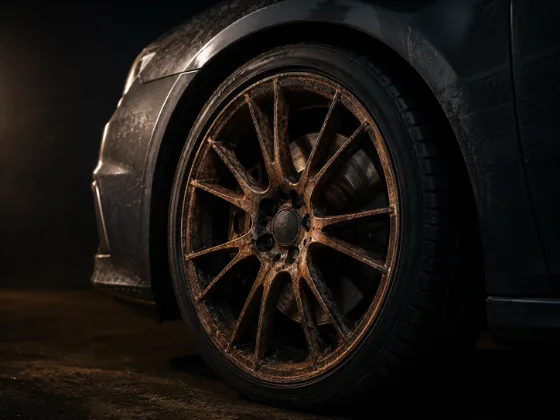
Brake dust is the grey-black powder that accumulates on your wheels — especially the front wheels, which do the majority of braking work. Most people treat it like ordinary dirt: annoying, worth washing off when it builds up enough to be noticeable. That's understandable, but it underestimates what brake dust actually is and what it can do to your wheel finish over time.
What Brake Dust Actually Is
Brake dust is the byproduct of your brake pads wearing against your brake rotors. Every time you apply the brakes, the pad material abrades against the rotor surface, and both the pad and the rotor shed microscopic particles. These particles mix with heat, rotor iron oxide, and residual brake fluid vapor — and the resulting compound is what settles on your wheel surfaces.
The composition of brake dust varies depending on brake pad type:
Organic / non-metallic brake pads (often called NAO — non-asbestos organic) use softer compounds based on materials like rubber, carbon, and various organic fibers. Their dust is softer, lighter in color, and less abrasive. Organic pads are common on economy vehicles and produce significantly less dust than other pad types. The tradeoff is that organic pads wear faster and are less effective at high temperatures.
Semi-metallic brake pads contain 30–65% metal fibers — steel, copper, iron — embedded in a composite matrix. These are the most common pads on American vehicles. Semi-metallic pads are durable, effective across a wide temperature range, and cheap to produce. Their brake dust is dark grey to near-black, heavy, and contains a high percentage of metallic particles — primarily iron. This iron content is what makes semi-metallic brake dust significantly more problematic for wheel finishes.
Ceramic brake pads use ceramic compounds and copper fibers rather than iron-heavy metal fibers. They produce lighter-colored, finer dust that's less likely to bond aggressively to wheel surfaces. Ceramic pads are more expensive but produce less wheel contamination and run cooler, which is gentler on rotors and brake components. The copper content in ceramic pads is being phased out due to environmental regulations in some states, with manufacturers transitioning to copper-free formulations.
Why Brake Dust Is More Than Just Dirt
The metallic particles in brake dust — particularly the iron particles from semi-metallic pads — are not inert. Iron oxidizes. In the presence of moisture, iron particles begin rusting. This isn't a slow background process; it happens relatively quickly when the wheel heats up and cools down through normal driving cycles.
When iron particles oxidize while they're sitting on your wheel surface, they can bond to the finish. The rust expands slightly as iron converts to iron oxide, and this expansion creates mechanical adhesion to the surface texture of the wheel coating. Brake dust that's been on a wheel for a few days is harder to remove than fresh brake dust. Brake dust that's been there for a few weeks and has gone through multiple wet/dry cycles is harder still. Brake dust that's been allowed to sit for months can become deeply bonded — requiring iron-removing chemistry or aggressive cleaning that risks the finish.
This is why brake dust shouldn't be treated as "dirt to wash off when it gets bad enough." It's chemically active contamination that bonds progressively more aggressively to your wheel surface the longer it sits.
What Happens If You Leave It
On clear-coated wheels (the most common finish on modern cars), bonded brake dust is first a cosmetic problem — the dust becomes visible as grey-black pitting or staining that doesn't wash off with normal car shampoo. As it progresses, the rust and expansion of the iron particles can cause micro-pitting in the clear coat surface. This pitting breaks the barrier function of the clear coat and exposes the underlying metal to further oxidation.
On polished aluminum wheels, bare or with very thin lacquer, bonded brake dust is more serious. Iron particles that oxidize against bare aluminum create a galvanic reaction — dissimilar metals in contact in an electrolyte (moisture and road salt are both electrolytes) accelerate corrosion on both surfaces. Polished wheels with heavy brake dust buildup that's been allowed to sit can develop permanent pitting in the aluminum surface that requires re-polishing to address.
On chrome-plated wheels, the chrome layer is designed to be corrosion-resistant, but it's a thin layer over nickel-plated steel. Brake dust that forces corrosion products under microscopic imperfections in the chrome can cause the chrome to lift — the characteristic bubbling of failing chrome. This is not reversible without re-plating.
The Iron Remover Difference
Standard car shampoo and most all-purpose wheel cleaners don't remove bonded iron particles from wheel surfaces — they clean loose contamination and some surface brake dust, but they don't address the iron that's oxidized and chemically bonded to the wheel finish.
Iron removers contain chemicals that chelate — chemically grab and dissolve — iron oxide. The most common active ingredient is a compound called ammonium thioglycolate, which forms a water-soluble complex with iron oxide. When you apply iron remover to a contaminated wheel, you see the purple-red reaction as the iron is pulled from the surface and into the chelated compound. That reaction shows you exactly where bonded iron was present.
Iron remover removes what shampoo and standard wheel cleaners leave behind. It's not a replacement for regular wheel cleaning — it's a decontamination step for the iron particles that accumulate despite regular washing. For most cars with semi-metallic brake pads driven regularly, an iron remover treatment on the wheels every 4–8 weeks is appropriate. Cars with ceramic pads can often go longer between iron decontamination.
Cleaning Protocol
For routine wheel cleaning (weekly to bi-weekly for most cars): rinse, apply pH-neutral wheel cleaner, agitate with soft brush, rinse thoroughly. This handles loose and surface-bonded brake dust and keeps contamination from accumulating between full decontamination sessions.
For full decontamination (monthly to bi-monthly): rinse, apply iron remover to the wheel face and barrel, let the reaction complete (the purple color will develop and then fade as the iron is chelated — typically 2–5 minutes), rinse thoroughly, then follow with wheel cleaner and agitation to remove the remaining contamination. Dry completely. Apply a wheel sealant or wax as protection.
Never let iron remover dry on the wheel surface. The chelated iron compounds can stain if allowed to dry. If you see it starting to dry before you've rinsed, spray water over it to re-wet and then rinse promptly.
Why the Front Wheels Get It Worse
Most braking force is applied at the front wheels — typically 60–70% of total braking load on a front-wheel drive or all-wheel drive vehicle. This means the front brake pads wear significantly faster than the rear, and the front wheels accumulate significantly more brake dust. It's common for front wheels to require cleaning twice as often as rear wheels. If you're prioritizing wheel care, the fronts need more attention.
Brake Pad Choice as a Wheel Care Decision
For drivers who detail their own cars and care about wheel cleanliness, brake pad choice matters. Switching from semi-metallic to ceramic pads on a daily driver significantly reduces brake dust accumulation — not just in color (ceramic dust is lighter and less visible) but in volume and bonding tendency. Ceramic pads cost more upfront but the reduction in wheel cleaning effort and the reduction in iron contamination damage over time is a real benefit. It's a worthwhile consideration at your next brake service.