Most people clean car carpet the same way they'd clean a countertop: spray something on it, scrub, wipe it up. This approach makes carpet look better. It does not make carpet actually cleaner. The dirt, soap residue, and contamination you're trying to remove mostly gets pushed deeper into the fiber or redistributed across the surface.
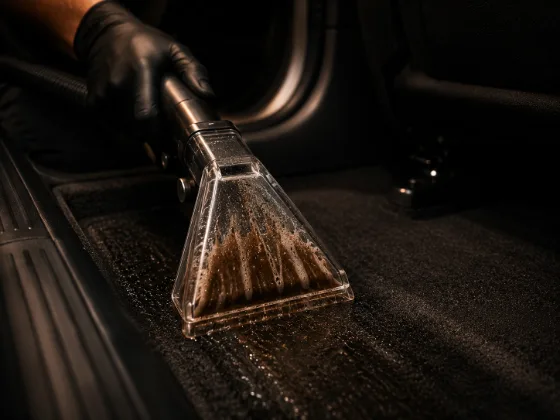
Extraction is different. It forces liquid through the carpet fiber and immediately vacuums it back out, along with whatever contamination was in the fiber. The result isn't just carpet that looks clean — it's carpet that is clean.
The Problem With Scrub-and-Wipe
When you spray a cleaner on carpet and scrub, you're breaking up the contamination and suspending it in liquid. When you wipe, you're pulling some of that liquid out. But you're leaving a lot behind — suspended contamination that re-deposits as the liquid dries. That's why carpet that was scrubbed and wiped often looks decent immediately after cleaning but gets dirty faster afterward and develops a dingy baseline over time. The residual cleaner left in the fiber also acts as a dirt magnet.
Extraction removes the liquid and the contamination together, in the same motion, before anything can re-deposit. No residue stays in the fiber.
Hot Water Extraction vs. Steam Cleaning
These terms get used interchangeably, but they're different things.
Hot water extraction uses heated water (not boiling — typically 120-180°F depending on the machine) at pressure, injected into the carpet, immediately vacuumed back out along with contamination. The heat improves cleaner performance and helps break up oils and stains. The pressure loosens fibers. The vacuum recovery removes everything. This is what professional carpet cleaning machines do.
Steam cleaning uses true steam at higher temperatures. It's effective for hard surfaces and upholstery but can be too harsh for some carpet fibers — it can also drive contamination deeper before removing it, depending on the method. Steam is useful for sanitizing and deodorizing but isn't the go-to for heavy carpet contamination removal.
For car carpet, hot water extraction is the right tool for serious cleaning. Steam has its uses but doesn't replace extraction for heavily soiled carpet.
Equipment Options
Dedicated automotive extractors: Machines like the Bissell Little Green, Mytee, or professional-grade units. These have a water tank, a pump that injects heated or warm water at pressure, and a vacuum recovery system. The spray-and-extract function is integrated — you trigger it in one motion. These are the most effective option for car carpet.
Shop vacs with extraction tools: Some shop vacuum setups allow wet extraction, but without the pressurized injection component, they're more effective at sucking up liquid you've applied manually than at the inject-and-recover approach of a true extractor. Still much better than scrub-and-wipe.
Upholstery attachments on household carpet machines: Bissell ProHeat and similar machines often have upholstery attachments that work reasonably well in car carpet. Not as powerful as a dedicated automotive extractor, but significantly better than manual cleaning.
If you're doing a thorough interior detail and you want carpet that's genuinely clean — not just visually improved — investing in a machine like the Bissell Little Green makes a significant difference. It's about $100-130, handles car carpet, seats, and floor mats, and pays for itself quickly if you're doing this regularly.
The Extraction Process
Remove floor mats. Extract them separately outside the vehicle — they need real attention and you need access to the carpet underneath them.
Vacuum thoroughly. Before any liquid goes on, vacuum the carpet deeply. Grit and loose debris in the carpet fiber will mix with your cleaning solution and become a slurry that's harder to extract. Remove as much dry contamination as possible first. Use a crevice tool for the edges and under-seat areas.
Pre-spray if needed. For heavily stained carpet or ground-in contamination, apply a dedicated carpet pre-spray or upholstery cleaner and allow it to dwell for 2-5 minutes before extracting. This gives the cleaner time to break down the contamination so extraction can pull it out. Don't let it dry — extract while it's still active.
Work in overlapping passes. Using the extractor, work in straight, overlapping passes. Move at a consistent pace — too fast and you don't inject enough solution; too slow and you saturate the carpet. Overlap each pass by about half to ensure even coverage.
Multiple dry passes. After you've done your cleaning passes, do additional dry vacuum passes — trigger the vacuum but not the water injection — to pull as much moisture out as possible. The drier you can get the carpet before it needs to dry on its own, the less risk of mildew and the faster the drying time.
Rinse pass (optional but recommended): For a truly thorough clean, do a final pass with clean water only — no cleaner — to flush any remaining surfactant residue out of the fiber. Cleaner residue left in carpet attracts dirt faster than clean fiber.
Specific Problem Areas
Driver's footwell: The most contaminated area in almost every car. Gets grit, salt, water, road debris, and constant foot traffic. Needs the most pre-spray time and the most passes.
Under seats: Rear seat footwells collect food, wrappers, pet hair, and anything that rolled under the seat. Use a crevice tool to vacuum first, then the extractor at an angle to get under the seat edges.
Cargo area / trunk: Carpet in cargo areas often takes abuse — wet items, sports equipment, dog crates. Same process, but often easier to access.
Floor mat backs: The back of rubber-backed floor mats traps grit between the rubber and carpet. Clean the carpet underneath the mat, not just the mat itself.
Stain Treatment
Fresh stains: blot immediately with a clean cloth, pressing straight down to absorb liquid rather than scrubbing (which drives the stain deeper). Then address with extractor as soon as possible.
Set stains: identify what the stain is if you can — the type of stain determines the best chemical approach. Protein stains (food, blood, coffee) respond to enzyme-based cleaners. Oil and grease stains respond to degreaser. Tannin stains (wine, berries) respond to specific tannin removers. Apply the appropriate pre-treatment, allow dwell time, then extract.
For unknown stains: start with an enzyme-based upholstery cleaner as a first attempt — it covers a broad range of organic contamination without being harsh on the fiber. If that doesn't work, try a more targeted approach.
Drying
Drying carpet properly is as important as the extraction itself. Wet carpet in a closed car creates the conditions for mildew — and a mildew smell is one of the hardest things to get out of a car interior once it's established.
After extracting, leave doors and windows open for maximum airflow. Point a shop fan into the footwells if possible. Don't put floor mats back in until the carpet underneath is fully dry. In warm weather, carpet typically dries in a few hours with good airflow. In cold or humid conditions, it can take considerably longer — overnight in some cases.
If you're in a hurry, a wet-dry shop vacuum pulling through the carpet after extraction removes more moisture than even a good extractor recovery pass. Get the carpet as dry as possible mechanically before relying on air drying.
How Often
Deep extraction cleaning once or twice a year is appropriate for most daily drivers. Vehicles with dogs, children, frequent passengers, or significant outdoor use — hiking gear, sports equipment — may need it more frequently. Between extractions, keeping up with regular vacuuming prevents contamination from building up and makes each extraction session faster and more effective.