
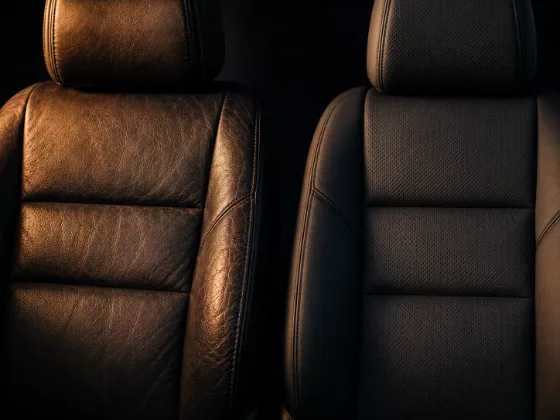
Car manufacturers call it "leatherette." "SensaTec." "Nappa." "Vegan leather." The marketing names vary, but the practical question is the same: is it real leather or not? And does it matter?
It matters a lot, because the cleaning approach that's ideal for genuine leather can be wrong for synthetic, and vice versa. Using the wrong products on either material gives you degraded results at best and damaged seats at worst.
The Landscape of Automotive "Leather"
Let's sort out what's actually in cars.
Genuine leather: Made from animal hide — typically cattle. Processed, tanned, and finished. In cars, it's almost always "corrected grain" leather, meaning the natural surface grain has been buffed off and replaced with a uniform embossed pattern, then coated with a polyurethane or acrylic finish for durability. Some luxury vehicles use "semi-aniline" or "full aniline" leather, where the surface is more natural and less coated. Price and brand tier generally determine which type.
Polyurethane (PU) leather / vinyl: Entirely synthetic. A fabric backing — usually polyester — coated with polyurethane or PVC on top. This is "leatherette," "SensaTec," "SofTex," "V-Tex," and dozens of other manufacturer trade names. It's designed to look and feel like leather. It's not. It behaves fundamentally differently from genuine leather and ages differently.
Bonded leather: A middle category — genuine leather scraps ground up, mixed with adhesive, and layered onto a fabric backing with a polyurethane top coat. It has some genuine leather content but behaves more like synthetic than like genuine leather. It also has a particular failure mode: it peels. Bonded leather often flakes and deteriorates badly, especially with heat and UV exposure. It's uncommon in modern vehicles but shows up in older cars and some budget seating.
Alcantara and microsuede: A different category entirely — a microfiber synthetic that mimics suede. Increasingly common on steering wheels, seat centers, headliners, and door panels in performance and sporty vehicles. Completely different cleaning requirements from either leather or vinyl. Covered in its own article.
How to Tell the Difference
Before you spend money on leather care products or apply anything to your seats, figure out what you're actually working with. Here are the reliable ways to tell.
Check the spec sheet: The easiest method. Pull up your vehicle's original spec sheet or window sticker. Any car manufacturer clearly identifies "leather" vs. "leatherette" or their equivalent trade name. If the spec says "sport cloth" or any synthetic trade name, it's not genuine leather. If it says "leather" with no qualifier, it almost certainly is — automakers can't call synthetic upholstery "leather" in their official documentation.
The back-of-the-material test: Look at the back side of any exposed material — under the seat lip, at the edge of the seatback. Genuine leather has a fibrous, suede-like back. Synthetic has a smooth fabric backing or shows the weave of the base textile. This is the most reliable physical test.
The smell test: Genuine leather has a distinctive smell, especially in warmer weather. Synthetic doesn't. This is subjective but useful as supporting evidence.
The temperature response: Genuine leather warms up to body temperature when you sit in it. Vinyl and PU synthetic stays cooler longer and can feel stiffer in cold weather. Not definitive but noticeable.
The surface texture up close: Look very closely at the grain pattern. On corrected-grain genuine leather, the grain pattern has subtle random variation — it's not perfectly uniform. On synthetic, the embossed pattern tends to repeat in a more regular tile-like way. You can see the difference under a phone camera zoomed in.
The water test: Place a drop of water on an inconspicuous area. Genuine leather will slowly absorb the drop over a minute or two. Synthetic will bead the water and it will sit on the surface. Note: modern coated genuine leather absorbs more slowly than raw leather — this test works better on aniline leather than on heavily coated corrected grain.
Why It Matters for Cleaning
The care differences between genuine leather and quality synthetic are less dramatic than you might expect for routine cleaning — both benefit from regular cleaning with a gentle cleaner and neither tolerates harsh solvents. But the differences matter for conditioning.
Genuine leather needs conditioning because it's an organic material. Without oils replenished periodically, it dries out, stiffens, and eventually cracks. The leather itself is the structural material, and it needs to stay supple.
Synthetic leather does not need conditioning in the same way. The "leather" surface is a polyurethane coating on top of a fabric backing. Polyurethane doesn't absorb conditioner — it just sits on the surface and can leave a sticky or greasy residue. What synthetic needs is UV protection and moisture resistance to prevent the polyurethane coating from becoming brittle and cracking. Some products marketed for "leather" care work well on both; others are genuinely leather-specific and do nothing useful on synthetic.
Failure Modes: What Goes Wrong With Each
Knowing how each material fails helps you prevent it.
Genuine leather: Dries and cracks, especially in hot climates with direct sun exposure. Color fades with UV exposure and aggressive cleaners. The protective coating wears off over time in high-contact areas (bolsters, cushion edges), leaving the underlying leather more vulnerable. Hard to repair once it's cracked — prevention is dramatically easier than cure.
Synthetic leather: The PU coating breaks down with UV exposure, heat, and certain chemical cleaners. You'll see it start to look dry, develop a "crazed" surface texture, or begin peeling at seams and high-flex areas. Some synthetics are also susceptible to certain cleaning chemicals that genuine leather handles fine — acetone, for example, will destroy a PU surface quickly. The fabric backing underneath can also absorb moisture and become a mildew risk if the top surface is compromised.
Bonded leather: The characteristic failure is delamination — the layers separate and the surface peels. This is accelerated by cleaning products, heat, and any moisture that gets into the adhesive layer. Bonded leather in poor condition can't really be saved; it peels progressively and eventually needs replacement or a seat cover.
Does Luxury = Genuine Leather?
Mostly, yes — but not always, and not always the leather you expect.
Most mass-market vehicles offer synthetic upholstery as standard and genuine leather as an upgrade. The trim level usually tells you which you have.
Luxury vehicles in the traditional sense — BMW, Mercedes, Audi, Lexus — generally use genuine leather as standard from a certain trim level up, though base trims sometimes use synthetic. Some brands have started offering premium synthetics as alternatives by consumer choice (vegan options in luxury trims from some European brands).
Some manufacturers that use genuine leather use surprisingly thin, low-quality hides that degrade faster than high-quality synthetics from other brands. Leather type, quality, and coating process vary significantly between manufacturers. "Leather" from one manufacturer isn't the same as "leather" from another.
Bottom Line for Your Cleaning Routine
Know what material you have before you buy products or start cleaning. Check the spec sheet — that's the definitive answer. If you genuinely can't determine it, the back-of-material test is reliable.
For genuine leather: regular cleaning with a pH-balanced leather cleaner followed by periodic conditioning is the maintenance model. Skip the conditioning and the leather will eventually fail.
For synthetic: regular cleaning with a gentle interior cleaner is sufficient. UV protection is valuable in sunny climates. Skip conditioning products designed specifically for leather — they don't help and can leave residue.
For bonded leather: treat gently, use minimal product, and understand that if it's already peeling, you're managing decline rather than maintaining condition.