
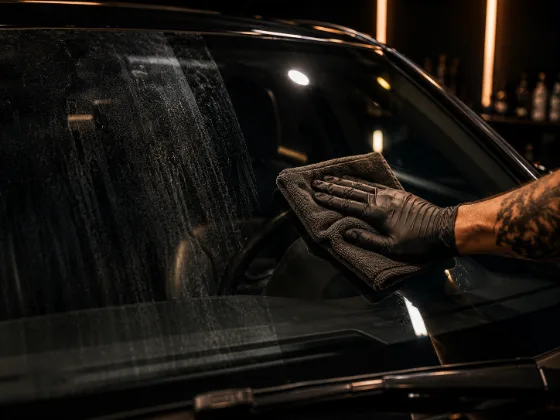
Streaky windows are one of the most common detailing frustrations, and they're almost never caused by a bad product. The cleaner gets blamed, but the real issues are technique, towel condition, and the order in which you work. Fix those three things and streaks stop being a problem regardless of which glass cleaner you use.
What Causes Streaks
A streak is a thin line of product residue or contamination that the towel moved rather than removed. The cleaner wasn't the issue — the issue is that the towel redistributed material instead of picking it up.
The main causes:
A saturated or dirty towel. When a microfiber towel is already loaded with glass cleaner and residue from previous passes, it can't absorb more. Instead of picking up what's on the glass, it smears it around. This is the most common cause of streaking — using one towel for the entire car's glass until it's soaking wet and leaving residue on every window.
Too much product. More glass cleaner doesn't mean a cleaner window. It means more product to remove, more chance of incomplete removal, and more streaks. A light mist is enough for most automotive glass. Two or three pumps of a pump sprayer is typically too much for a single window.
Cleaning in direct sunlight or on a hot surface. Glass cleaner evaporates fast. In direct sunlight, it evaporates faster than you can wipe it off, leaving the surfactants and any dissolved contamination behind as a film or streak. This is why windows cleaned in the sun often look worse than windows cleaned in shade even with identical technique.
Wrong towel material. Paper towels leave lint and fiber on glass. Low-quality microfiber towels scratch and smear rather than pick up. Dedicated glass microfiber towels — typically a tight, short-nap weave — are noticeably better than all-purpose microfiber on glass.
Ammonia residue on tinted glass. On factory tint or aftermarket tint film, ammonia-based cleaners can leave a persistent haze that shows up as streaking. (More on this in a separate article — but tinted windows need an ammonia-free cleaner.)
The Two-Towel Method
The single most effective change you can make to your window cleaning process is switching to two towels per window. It eliminates the redistribution problem completely.
Towel 1: The applicator. Spray glass cleaner lightly onto this towel (or directly onto the glass with a light mist) and wipe the glass in straight strokes — horizontally across the top half, then vertically down the lower half. This towel does the cleaning work and picks up most of the contamination.
Towel 2: The buffer. Immediately after Towel 1, use a clean, dry glass towel to buff the surface in the opposite direction — if Towel 1 went horizontal, Towel 2 goes vertical. This catches any remaining product and eliminates the streaks left by the first towel.
The directional difference matters for a practical reason: if you have residual streaking, you can tell from the direction of the streak which towel caused it. A horizontal streak came from Towel 2 (it missed something from Towel 1). A vertical streak came from Towel 1 (Towel 2 didn't catch it). This makes troubleshooting easy.
Inside vs. Outside: Different Problems
The outside of car windows gets road grime, bug splatter, water spots, and environmental fallout. These are relatively easy to remove with standard glass cleaner.
The inside of car windows is different. It accumulates a film from outgassing — the plasticizers, adhesives, and vinyl compounds in the interior releasing gas over time and depositing a thin, oily layer on the glass. This is the film that makes the inside of the windshield hazy. It's not the same as dust, and it doesn't respond well to a light wipe. It needs a glass cleaner with enough surfactant to actually cut through an oil-based film, applied with enough pressure to break the film's adhesion to the glass.
The inside of the windshield also requires dealing with the geometry problem: you're wiping glass that's angled at roughly 60 degrees, your arm is extended awkwardly, and the A-pillars block access to the corners. A microfiber pad on a pivoting handle — often called an interior car window tool — solves the geometry problem. It reaches the center of the windshield without contortion and gives you even pressure across the glass.
Order of Operations
Clean exterior windows before interior windows. If you clean interior first, then open the door to clean the outside, you'll smudge the interior glass with your arm crossing over it.
Clean the inside of the door glass after the door is open — not through the interior of the car. Roll the window down halfway, clean the exposed top edge, then roll it up and clean the rest. Most people skip the top edge of the glass (the part that rolls into the door seal) and then wonder why there's a smudge that reappears every time the window goes down.
Towel Maintenance
Glass microfiber towels need to be laundered frequently and separately from other detailing towels. Microfiber picks up wax, sealant, and silicone residue from other surfaces — wash a glass towel in the same load as your LSP application towels and you'll get product transfer onto the next window you clean with it.
Wash glass towels in hot water with no fabric softener. Fabric softener coats the microfiber fibers and dramatically reduces their ability to pick up product and contamination. If your glass towels have been washed with fabric softener, they need to be stripped (washed multiple times in hot water with a small amount of dish soap) before they'll work properly again.
The Final Check
When you're done, check your work by looking through the glass at a dark background at multiple angles. Look through the glass toward a dark wall or the shaded side of a building. Streaks that were invisible in direct light will show up as light haze against a dark background. If you see them at this stage, a quick final buff with a clean, dry glass towel usually resolves them.
Then do a final check from outside the car, looking at the glass in reflected light — not through it. A hazy or streaky outside surface shows up in reflection even when it looks clean from the inside looking out.