Compound and polish are both abrasive products that correct paint defects. This causes most of the confusion — if they both cut, what's actually different? The answer is the aggressiveness of the abrasive, the finish quality they leave, and the situations where each one is appropriate.
Using a compound when you need a polish does unnecessary damage. Using a polish when you need a compound means nothing happens. Getting this right is the foundation of effective paint correction.
The Shared Principle
Both compound and polish work on the same principle: abrasives suspended in a liquid or paste medium are worked across the paint surface under friction. The abrasive particles cut into the clear coat, removing a thin layer of material and leveling out imperfections. When the scratched or damaged material is removed, the remaining surface is even and reflects light uniformly — which is what a corrected, glossy paint finish looks like.
The variable is the abrasive. Abrasive particles come in different sizes, hardnesses, and shapes. Larger, harder, sharper abrasive particles cut more aggressively. Smaller, softer, rounder abrasive particles cut more gently and leave a finer finish. This is the fundamental axis that separates compound from polish.
What a Compound Is
A compound (also called cutting compound, cutting polish, or heavy compound) contains larger, more aggressive abrasive particles — typically aluminum oxide or silicon carbide. These particles cut into the clear coat more deeply and efficiently, removing more material per pass.
Compounds are designed to address significant paint defects:
- Deep scratches and heavy swirl marks
- Oxidation and UV damage
- Water stains and mineral etching that has penetrated into the clear coat
- Sanding marks from wet sanding or factory paint imperfections
- Heavy surface contamination that can't be removed chemically
A compound will fix these defects quickly and efficiently. But it also leaves its own marks — the abrasive particles that cut out the deep scratches leave finer scratches of their own in the process. After compounding, the paint looks much better than before but still has haze and micro-scratches from the compound itself. This is called "compound haze" or "buffer trails."
Compound is typically the first step in multi-stage paint correction, not the final step.
What a Polish Is
A polish (also called finishing polish, swirl remover, or light polish) contains much smaller, finer abrasive particles. These particles remove significantly less material per pass and leave a much finer finish.
Polishes are designed to address:
- Light swirl marks and fine scratches
- Light oxidation and surface haze
- Compound haze — removing the scratches left by compounding
- Water spots that haven't deeply etched
- General paint refinement and gloss enhancement
A polish removes minor imperfections that compounding would be overkill for, and it refines the finish left by a compound. After polishing, the paint should have a clean, deep, high-gloss finish with no visible scratches or haze. This is the typical final correction step before protection is applied.
How They Work Together
Paint correction is often a two-stage process precisely because of how compound and polish are designed. Stage one: compound to remove the significant defects — deep scratches, heavy swirls, oxidation. Stage two: polish to refine the finish, remove compound haze, and bring the paint to a final high-gloss result.
Some situations only need one stage. If the defects are light enough — mild swirl marks, surface haze — a polish alone can correct them without needing compound first. If paint has only compound haze and no underlying deep defects, a polish alone cleans up the result.
But paint with deep scratches or heavy swirl marks polished without compounding first will see minimal improvement — the polish simply doesn't cut deep enough to reach the problem. This is the most common mistake beginners make: buying a light polish and being frustrated when it doesn't fix the significant swirls they were trying to address.
Understanding Abrasive Technology
Modern polishes and compounds often use diminishing abrasive technology. Traditional abrasives maintain their size throughout the cutting process. Diminishing abrasives actually break down into progressively smaller particles as they work — so a compound that starts aggressive becomes progressively finer during use, approaching a polish-like finish as the abrasive particles are worn down.
This technology allows single-product approaches in some situations — a diminishing abrasive compound can address significant defects and then refine its own finish as it's worked further. However, these products still don't typically produce as refined a final finish as a dedicated finishing polish on the last pass.
Machine vs Hand Application
Both compound and polish can be applied by hand or with a machine polisher (DA — dual-action orbital — or rotary). Machine application produces significantly better results: the consistent, controlled action of a machine generates more even abrasion than a human hand, produces better paint correction results, and is dramatically more efficient on large areas.
Rotary polishers are more aggressive than DA orbiters — they spin the pad in a true circle, which generates more heat and more cutting power. In experienced hands, a rotary corrects paint faster and more effectively. In inexperienced hands, a rotary can burn through clear coat quickly.
DA (dual-action) polishers are safer for beginners. The random orbital action reduces the risk of burning through clear coat and still produces excellent results — just more slowly than a rotary.
Hand correction with compound or polish is realistic for very small areas (spot correction on a single panel) but impractical for whole-car correction. The results by hand are also significantly less even and effective than machine results.
Pad Selection Matters Too
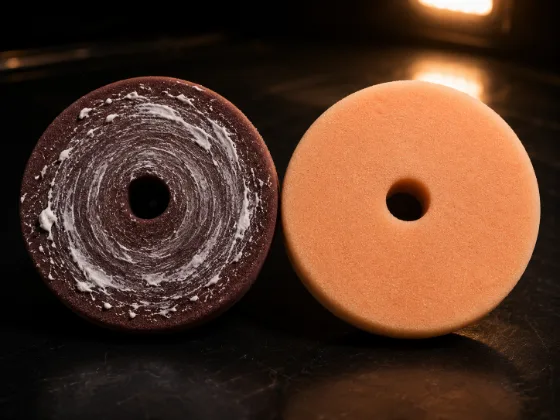
The correction pad you pair with the compound or polish affects the aggressiveness of the cut. Cutting pads (typically orange or yellow, denser foam) increase aggressiveness. Polishing pads (typically white or blue, softer foam) decrease aggressiveness and produce a finer finish. Finishing pads (black or gray, very soft) are the gentlest.
The same compound on a cutting pad cuts more aggressively than on a polishing pad. The same polish on a cutting pad might behave more like a compound. This gives you flexibility — you can dial in the aggressiveness of your correction setup by combining product and pad choices.
A Simple Guide to Choosing
Light swirl marks, surface haze, minor scratches: Start with a polish on a polishing pad. If that doesn't fully address the defects after a full panel pass, move to a more aggressive combination.
Moderate swirl marks, heavier scratches, light oxidation: Start with a compound on a cutting pad. Follow with a polish on a polishing pad to refine.
Heavy oxidation, deep scratches, sanding marks, aggressive defects: Compound on a cutting pad is required first. Multiple compound passes may be needed before polishing stage.
Only compound haze or fine polisher scratches: Polish alone on a polishing or finishing pad is all you need.
What to Expect After Correction
After a complete two-stage correction (compound + polish), paint that was properly corrected on a well-maintained clear coat should have a finish that surpasses factory quality. The factory doesn't typically polish paint to the same standard a careful detailer achieves. Deep, even gloss with no visible scratches or haze in any light — that's the result a proper two-stage correction delivers.
Apply protection as soon as possible after correction. Freshly corrected paint is exposed — no wax, no sealant, no ceramic. It's also at its best visual quality, and a good protection product locks in that result. A corrected paint surface with fresh protection on it is as good as that paint will ever look.