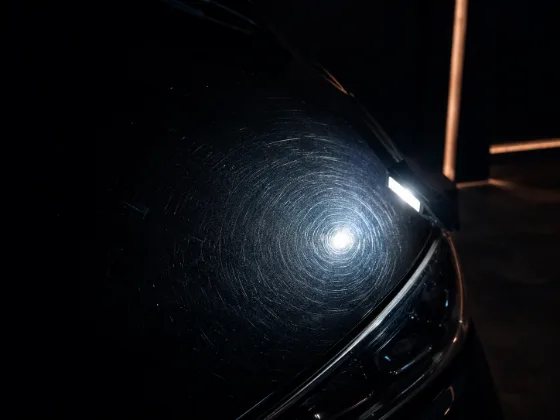
You wash the car, it looks great in the shade, and then you pull it into sunlight or park it under a bright light source and the paint looks like a spider web. Circular scratches, haze, a dull look that wasn't there in the garage. Those are swirl marks, and virtually every car that's been washed more than a handful of times has them.
Understanding where swirl marks come from is the first step to preventing new ones and addressing the existing ones. The causes are almost entirely about contact — specifically, improper contact with the paint during washing and drying.
What Swirl Marks Actually Are
A swirl mark is a fine scratch in the clear coat. The pattern looks circular or arc-shaped when viewed under direct light because of how the scratch was made — a cloth or pad moving in a circular or sweeping arc over the surface — but it's fundamentally just a scratch in the top layer of your paint.
Automotive clear coat is a hard, transparent polymer layer, typically 2–4 mils thick (0.002–0.004 inches). Swirl marks live in the top fraction of that clear coat — usually the first 0.5–1.5 mils of depth. They don't penetrate all the way through the clear coat into the base coat (color layer) in most cases. This is important because it means they can often be corrected by removing a thin layer of the clear coat surface — the same way you'd sand out a scratch in wood.
What makes swirl marks visible is how they interact with light. A smooth, swirl-free clear coat surface reflects light evenly and the paint looks deep and glossy. A scratched surface scatters light in different directions from each scratch — the paint looks dull, hazy, or gray under direct light. The circular pattern of the scratches creates the distinctive "holograms" or "spiderwebs" that are the visual signature of swirl damage.
Where Swirl Marks Come From
The vast majority of swirl marks come from washing and drying. Not from road debris. Not from environmental factors. The most damaging thing that typically happens to your car's paint is the act of cleaning it — done wrong.
Improper washing technique. Scrubbing the paint with a circular motion while washing is the textbook cause of swirl marks. The friction from the wash mitt moving in a circle creates circular scratches. Using a back-and-forth, straight-line motion instead of circles significantly reduces swirl mark formation — the scratches still happen, but they're linear rather than circular, less visually distracting, and easier to correct.
Dirty or contaminated washing media. A wash mitt or sponge that has picked up grit, debris, or dirt particles from a previous panel becomes an abrasive — those particles are trapped in the fibers and are dragged across the paint with every pass. The two-bucket wash method (one bucket for clean soap solution, one bucket to rinse the mitt before reloading) exists specifically to address this problem.
Insufficient lubrication. Dry-wiping paint — wiping a panel that doesn't have enough water or shampoo solution as lubrication — concentrates friction on the high points of the paint surface rather than allowing the wash media to glide. Even a relatively soft cloth can scratch paint when there's not enough lubrication between the cloth and the surface.
Automatic car washes. Tunnel car washes with brushes are the most efficient swirl mark creation tools available to the general public. The brushes spin in circular patterns, trap grit from previous vehicles, apply high pressure, and are used on hundreds of cars per day with essentially no concern for the paint. A single pass through a brush-type automatic wash can undo significant detailing work. The swirl marks from automatic washes are often dense and deep compared to hand-washing swirls.
Drying with the wrong materials. Drying paint with a rough, gritty, or low-quality towel creates swirl marks just as effectively as washing improperly. Old bath towels, chamois cloths, and microfiber towels that haven't been properly maintained all create fine scratches during drying. High-quality, clean, plush microfiber towels or a forced-air dryer (which avoids contact entirely) are the right tools for drying.
Wiping paint with anything dry. Dusting a car by wiping a dry cloth across the paint surface, quickly "cleaning" a spot with a dry rag, or wiping a dirty panel without any lubrication are all reliable ways to create fine scratches. Any time you wipe dry paint, you're dragging whatever dust and contamination is present across the clear coat.
Detail spray or quick detailer on a dirty car. Quick detailers and spray waxes are designed to be applied on clean paint. Spraying a quick detailer on a dusty or dirty car and wiping it in is essentially washing a dirty car with a cloth and no water — dragging particles across the surface with some lubrication but not enough to prevent scratching.
Factors That Make Swirl Marks More or Less Visible
Not all cars show swirl marks equally. Several factors affect how visible they are:
Paint color. Dark colors show swirl marks dramatically more than light colors. Black and dark blue paint makes every fine scratch visible under any reasonably bright light source. White and silver paint scatter light in a way that hides swirl marks — a white car that looks flawless under show lighting might look terrible if it were painted black. This isn't because light cars have fewer swirl marks — they typically have just as many — it's that the marks are harder to see.
Paint hardness. Softer paints scratch more easily. Many German and Japanese paint systems are notably soft — BMW, Mercedes, and Porsche paint in particular has a reputation for scratching easily. Harder paint systems, like many Korean and American vehicles, resist swirl mark formation better but are harder to correct once scratched.
Current protection level. Fresh wax, sealant, or ceramic coating adds a buffer between the washing media and the clear coat. This doesn't make the paint immune to swirl marks, but it means the coating takes some of the damage instead of the clear coat — and some protection products, particularly ceramic coatings, provide better resistance to fine abrasion than the clear coat alone.
Lighting conditions. Swirl marks are almost invisible in indirect or diffuse lighting and strikingly visible under direct, bright, point-source light. Fluorescent shop lights with panels directly overhead, direct sunlight, and bright single-source exterior lights reveal swirl marks that look nearly invisible indoors under soft lighting.
Assessing How Bad Your Swirls Are
Pull the car into bright direct light — sunlight works, a bright single-panel fluorescent works, a detailing light specifically works. Look at the paint from a slight angle, rotating around the panel. You're looking for the characteristic spiderweb or circular pattern in the reflection.
Light swirls: visible in direct light, paint still has reasonable gloss, no depth to the scratches. These respond well to a light polish.
Moderate swirls: visible in most light conditions, paint looks hazy rather than clear, gloss is noticeably diminished. These need a more aggressive polish or light compound.
Heavy swirls or deep scratches: visible in indirect light, paint looks dull at most angles, scratches may catch your fingernail. These need a compound and multiple correction stages.
The Good News
Swirl marks in the clear coat are fixable in most cases. Paint correction — polishing with abrasive compounds to level the clear coat surface — removes the scratched material and restores an even, reflective surface. The process is time-consuming and requires some skill to do without creating new damage, but the results on properly executed paint correction are dramatic.
After correction, better washing habits and quality protection prevent new swirl marks from accumulating at the same rate. A car that's been corrected and is then washed with proper two-bucket technique and quality media using straight-line motion will stay significantly swirl-free far longer than it did before.