
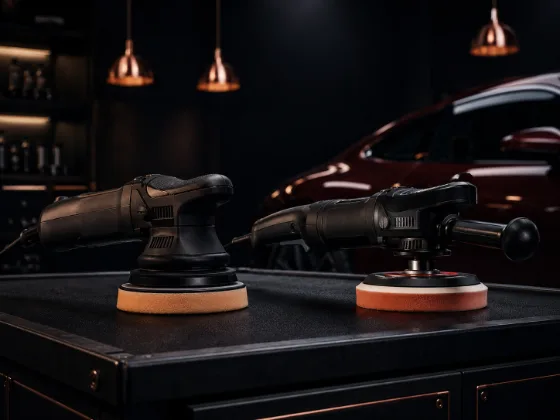
Two machines dominate paint correction: the DA orbital polisher and the rotary polisher. They both spin a pad against paint to remove defects, but the mechanics underneath are completely different — and those mechanics decide how forgiving the machine is, how fast it cuts, and whether a beginner should touch it at all.
If you're shopping for your first polisher, this is the decision that matters most. Get it wrong and you either buy something too aggressive that damages paint, or spend years being frustrated by a machine that can't do the work you need.
How a DA Polisher Works
DA stands for dual-action. The pad moves in two ways simultaneously: it rotates around its own center axis and oscillates in a circular path around an offset point. Picture a planet rotating on its axis while also orbiting the sun — that's the motion pattern. Because of this eccentric orbit, the pad never drags the same patch of paint in the same direction twice. The cutting action is randomized.
That randomness is exactly what makes a DA forgiving. Heat buildup — the primary cause of burned paint and holograms — requires consistent friction in one spot. The DA's orbit naturally distributes that friction and prevents hot spots from developing. You can keep the machine in one area longer, run it at higher speeds, and make more passes without the paint underneath getting hot enough to cause damage.
True random orbit DAs (often called "free rotation") let the pad stop rotating under heavy pressure — the orbital motion continues but the spin stops. This is a safety feature. When you press hard, the machine backs off its cut rather than pressing through. The tradeoff is that maximum correction speed is limited.
Forced Rotation DAs: The Middle Ground
Higher-end DAs add a gear mechanism that forces the pad to rotate even under heavy pressure. The orbital motion stays the same, but now the pad never stops spinning regardless of how hard you lean on it. This gives you more cutting power while preserving the randomized orbit that prevents holograms.
Forced rotation DAs — machines like the Rupes Bigfoot or Flex 3401 — sit between a true random orbit DA and a rotary in terms of aggressiveness. They correct paint faster and tackle harder defects than a basic DA, but they're still considerably safer than a rotary. The orbit keeps the motion pattern unpredictable enough that holograms and burning paint are still difficult to achieve even with inexperience.
If you're a serious hobbyist who wants more correction capability without going full rotary, a forced rotation DA is worth considering. For pure beginners, a standard random orbit DA is the right starting point.
How a Rotary Polisher Works
A rotary polisher does exactly what the name implies: the pad spins in a single direction around a fixed center axis. There's no orbital offset, no randomized motion. The pad tracks the same path on the paint with every revolution.
That single-axis spin creates significantly more friction per square inch than a DA orbital. More friction means more cutting power and more heat. A rotary can correct paint faster than a DA in skilled hands. It can tackle severe oxidation, heavy scratches, and very hard paint systems that a DA would need hours to address — because the rotary simply removes more material per pass.
The heat and the consistent motion pattern are also what creates the rotary's characteristic risks. Too much heat burns the clear coat — softening, hazing, or permanently damaging it. Keeping the pad moving consistently across the panel is critical; pausing or applying uneven pressure leaves tracks and buffer trails baked into the paint. And because the abrasion pattern is consistent, even light rotary work can leave fine holograms — swirl-like marks in a consistent circular pattern — if the pad and product combination isn't right or the finishing pass isn't performed correctly.
Skill Requirement
A DA polisher is genuinely beginner-friendly. It does not require technique to avoid damaging paint — the mechanical design does that for you. Beginners make mistakes with DAs (wrong pad, wrong speed, too much product, staying in one spot too long) but those mistakes are recoverable. Burning through clear coat with a DA requires deliberate misuse.
A rotary is not beginner-friendly. Burning paint with a rotary requires only a moment of inattention — holding the pad stationary at high speed, running too hot, working dry paint. The technique required to avoid damage while maximizing correction is not intuitive and takes real-world experience to develop. Professional detailers learn rotary use over time, often on panels and junk cars, before putting one on a customer vehicle.
If you've never polished paint before, do not start with a rotary. Full stop. You will damage paint before you understand how to prevent it.
Correction Capability
A DA polisher handles the vast majority of paint correction work most people actually encounter: swirl marks from improper washing, light scratches, oxidation, water spots, and surface haze. With the right compound and pad combination, a DA removes moderate-to-severe defects — it just takes more passes and more time than a rotary would.
Where a rotary genuinely outperforms a DA is in two situations: severe oxidation (chalky, heavily degraded clear coat) and extremely hard paint systems. Some factory paint hardeners, particularly on German vehicles, are dense enough that a DA at full speed barely cuts. A rotary cuts through them efficiently. Severe oxidation can require so many DA passes that the job becomes impractical. A rotary powers through in a fraction of the time.
For 95% of hobbyist work on maintained vehicles, a DA is sufficient. The correction a DA delivers on light-to-moderate defects is indistinguishable from rotary results when properly performed.
What Throw Size Means
DA polishers are specified by their orbital throw — the diameter of the eccentric circle the pad traces. Common throws are 8mm, 15mm, and 21mm.
A larger throw means the pad covers more ground per revolution and distributes abrasion across a wider area per pass. A 21mm throw machine corrects paint faster and with less risk of heat buildup than an 8mm throw machine, because the friction is spread over more surface. For most use cases — whole-panel correction, swirl removal — a 15mm or 21mm throw is the right choice.
Smaller throw machines (8mm-12mm) are used for tight areas: around mirrors, door handles, curved body lines, and areas where a larger pad can't reach cleanly. Some detailers keep a small-throw machine specifically for spot correction and tight panel work alongside a larger machine for open panel work.
For a first machine, buy a 15mm or 21mm throw. The larger throw does the work more efficiently and is more forgiving. You can figure out tight-area work with technique before deciding you need a second machine for it.
Speed Settings
Both DA and rotary polishers have variable speed settings, typically numbered 1-6 and corresponding to RPM ranges. On a DA, speed controls how fast the pad orbits and rotates. On a rotary, speed directly controls how many revolutions per minute the pad makes.
Higher speed means more abrasion and more heat. The general rule for DAs: start at a medium speed (3-4 out of 6) for your first pass on a panel and adjust based on results and heat. For rotaries, speed control is a core technique skill — you run higher speeds for cutting but drop speed for finishing passes and never park the machine in one spot at high speed.
On a DA, running too slow is usually the mistake beginners make — they're nervous about damaging paint and use speed 1-2, which doesn't generate enough heat to activate the product properly. Products need some heat to break down abrasives and work correctly. On a rotary, running too fast too long is the common mistake.
Pad Compatibility
Both machine types use foam pads, but there are size and interface differences to know about. Most DA polishers use a 5-inch or 6-inch backing plate with pads in the corresponding size range. Backing plates attach via hook-and-loop (velcro) and pads attach to the backing plate the same way.
Rotaries typically use larger pads — 6 to 8 inches — with stiffer backing plates, because the rotary motion creates different force distribution than a DA orbit. Using a pad designed for a DA on a rotary (or vice versa) usually works mechanically but may not perform optimally or may wear the pad unevenly.
Both machines use cutting, polishing, and finishing pads in various foam densities. The same pad naming conventions apply — cutting pads are denser and increase aggressiveness, finishing pads are softer and reduce it. The principles of pad selection are identical regardless of which machine you're running.
When You Should Seriously Consider a Rotary
A rotary makes sense when you're doing professional correction work, when vehicles have severe oxidation that would take impractical DA pass counts to address, when the paint system is genuinely hard enough that a DA can't cut it efficiently, or when you need to remove wet-sanding marks and want to work quickly.
It also makes sense once you have enough machine experience that the technique requirements aren't a liability. Detailers who've spent real time with a DA — who understand how paint responds to different pad and product combinations, who can read the surface as they work, who know what heat feels like under a pad — can pick up a rotary and develop technique without damaging cars. The knowledge transfers; only the machine behavior is new.
If you're asking whether you should buy a rotary as your first machine, the answer is no.
The Verdict for Beginners
Buy a DA polisher with a 15mm or 21mm throw. That machine will handle everything you need for years. Swirl removal, oxidation correction, single-stage paint, paint defect work before protection — a DA handles all of it. The results you get from a well-executed DA session are excellent and not meaningfully different from rotary results on most hobbyist jobs.
Rotary polishers are professional tools with professional learning curves. They're faster, they cut harder, and they're more capable in specific situations — but those situations are narrower than the marketing makes them sound, and the risks are real for anyone who hasn't developed the feel for them.
The DA is not a compromise. It's the right tool for where most people are starting, and it stays the right tool for most work even as you develop more experience. Save the rotary conversation for when you've done enough correction work that you genuinely understand what you'd be adding — and what you'd be risking.