Search for "car detailing kit" and you'll find products ranging from $25 to $500, most of which include things you don't need and are missing things you do. The detailing industry has a bad habit of overselling gear to beginners. So let's cut through it.
Here's what you actually need to get started — organized by priority, not by what looks impressive in a photo.
Tier 1: Non-Negotiables
These are the things without which you can't do a safe, proper exterior wash. If you only buy one tier, make it this one.
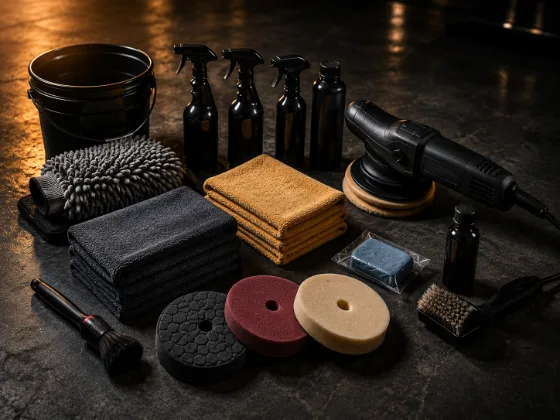
Two buckets. Not one. Two. Five-gallon buckets, ideally with grit guards in the bottom. One for your soapy wash water, one for rinsing your mitt between panels. This is the mechanical backbone of scratch-free washing. Don't skip it.
A quality wash mitt. Microfiber or lamb's wool. Not a sponge. Sponges have flat, hard surfaces that trap grit against the paint. A proper wash mitt has long, plush fibers that encapsulate dirt and pull it away from the surface. One good mitt is all you need to start.
Microfiber towels — at least 8, ideally 16. Buy more than you think you need. You'll use separate towels for drying, interior surfaces, glass, and product buffing — and you should never cross-contaminate them. The $2 microfibers from the big box store work for interior use; spend a little more for the towels that touch paint.
A quality car shampoo. pH-balanced, lubricating, and safe on wax or coating if you've applied any. The shampoo you pick matters more than most beginners think — not because an expensive shampoo makes your car shinier, but because a good shampoo produces slick, lubricated wash water that lets your mitt glide instead of drag.
A spray bottle. Sounds obvious, but you'll need one for diluting your pre-wash or any APC. Buy a couple — a good chemical-resistant spray bottle costs less than $5 and is one of those tools you'll constantly reach for.
Tier 2: Strongly Recommended
Once you have the basics, these additions make a real difference in both results and protection.
A spray wax or quick detailer. Applied after washing and before or during drying, this gives your paint a protective layer that takes weeks instead of seconds to apply. Used as a drying aid, it adds lubrication that makes drying safer and faster. This is the single most time-efficient protection product in detailing.
An all-purpose cleaner (APC). A dilutable APC handles the stuff your shampoo can't — engine bay surfaces, door jambs, wheel wells, floor mats, grimy door handles. Most APCs dilute differently for different jobs: weaker for sensitive surfaces, stronger for heavy grime. One bottle replaces a dozen different specialized sprays.
A pre-wash or snow foam. Applied before you touch the car with a mitt, a pre-wash solution loosens and emulsifies contamination that would otherwise get dragged across your paint. This is the step that separates safe washing from washing that scratches. You don't need a foam cannon to do it — a spray bottle works fine.
A glass cleaner. Don't use household ammonia-based glass cleaners on car windows. They attack window tint, degrade rubber seals, and leave streaks. An automotive glass cleaner is streak-free and tint-safe.
A tire dressing. Clean tires without dressing look clean but unfinished. A good tire dressing brings the look together and provides some protection against UV cracking. More on what to look for below.
Tier 3: Nice to Have (But Not Yet)
These are tools you'll eventually want, but they're not necessary to get started — and buying them before you have the fundamentals down is putting the cart before the horse.
A foam cannon. Attaches to a pressure washer and applies a thick layer of foam for a better pre-wash. Great tool, real benefits — but it requires a pressure washer, and the technique matters. Learn the two-bucket method first.
A pressure washer. Excellent for pre-rinsing, wheel wells, and engine bays. A garden hose with a good nozzle is a fine starting point. Don't buy a pressure washer because you think you need it for a basic wash.
A clay bar kit. Used for decontamination — pulling bonded contamination out of the clear coat. Not something you need every wash, but essential before applying any protective coating. Do your first few washes with the basics before you go here.
A machine polisher. This is what corrects swirl marks and scratches. The dual-action polisher is the beginner-friendly option. But this is a skill that takes practice, and you need to have your washing technique down before you correct damage — otherwise you'll just add more while you wash.
A Note on Towel Contamination
The most common mistake beginners make with towels: using the same towel for everything. Your towels need to be dedicated and labeled. Paint towels touch only paint. Interior towels touch only interior surfaces. Glass towels touch only glass. Wheel towels never touch paint.
Why? Because a towel that's been used on a wheel or door jamb will have brake dust, grit, and harsh chemical residue in it. Drag that across a panel of paint and you're putting serious scratches in it. Color-code your towels or tag them with colored tape — it takes thirty seconds and saves you from an expensive mistake.
What You Don't Need
A few things the kits always include that you should skip:
Chamois. Traditional chamois (synthetic or natural) are fine for drying if used correctly, but they're less forgiving than a good microfiber. A quality waffle-weave microfiber drying towel is better in almost every way.
Detailing brushes (12-pack). You'll use maybe two of them. An interior detail brush and a wheel brush cover 90% of what you need. The rest are specialty tools you'll find uses for later.
A "detailing spray" that claims to do everything. These products don't correct, protect, clean, and shine all at once. Pick products that have a specific job and do that job well.
The Bottom Line
Two five-gallon buckets, grit guards, a good wash mitt, quality microfibers, a pH-balanced shampoo, a pre-wash, and a spray wax. That's your starting kit. Everything else comes later, when you know what you're doing and what problems you're actually trying to solve.
The most important tool in detailing isn't a product. It's understanding why each step matters. Products without technique are just expensive ways to scratch your car more efficiently.