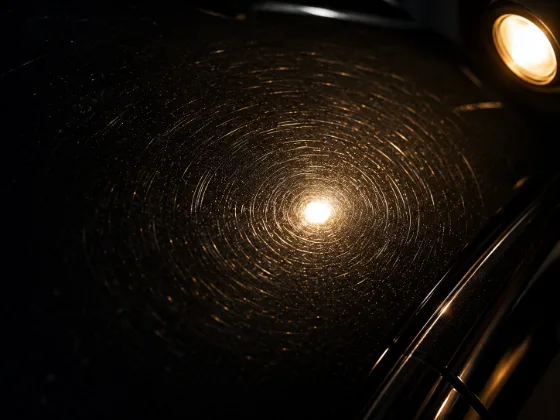
Go look at your car in direct sunlight, ideally with the sun at a low angle. Not a glance — actually stop and look at a panel. If you've had the car more than a year and used any kind of car wash service, you'll see them: a web of fine, circular scratches across the paint. They're most obvious on dark colors, but they're on every car.
These are called swirl marks. And almost nobody knows where they actually come from.
It Wasn't Road Debris
Most people assume the scratches on their paint came from highway driving. Gravel. Bugs. The occasional rock chip. Those happen, and they cause damage — but rock chips look like rock chips. They're small, isolated, and deep. Swirl marks are different. They're everywhere, they're uniform, and they have a very specific cause.
Swirl marks come from washing.
More specifically, they come from dirt being dragged across your paint under pressure. Every time something contacts your paint — a brush, a towel, a wash mitt, even a chamois — it has the potential to drag whatever contamination is on the paint surface across the clear coat. And clear coat, for all its usefulness, is soft enough to scratch with everyday grit and road dust.
The Single Biggest Offender: Tunnel Car Washes
If you use a drive-through tunnel wash with spinning brushes, you are definitively swirling your paint. There is no version of this that doesn't cause scratch damage.
Here's the problem: those rotating brushes contact every car that goes through. The brushes pick up contamination — grit, road debris, dried bugs — from each car and carry it to the next one. By the time the brush hits your car, it's loaded with abrasive material from the previous fifteen vehicles. The spinning motion turns that grit into a fine-grit sanding wheel, and it carves circular scratches into your clear coat on every pass.
Touchless washes are better (nothing is physically contacting the paint), but they rely on extremely aggressive chemistry to compensate for the lack of agitation, which has its own long-term effects on wax and sealant protection.
The Second Biggest Offender: Single-Bucket Washing
Hand washing with a bucket sounds like the safe option. It can be — but most people do it in a way that guarantees swirl damage.
The typical approach: fill a bucket with soapy water, load the mitt, start washing. After a panel, dip the mitt back in the bucket to reload it with soap. Repeat until the car is done.
The problem is the dip. When you finish a panel and dip your mitt into the bucket, you're transferring all the grit that mitt just picked off your paint into the wash water. Now your soapy water is a slurry of dirt and road grime. The next time you load that mitt, you're loading it with abrasive particles. And then you drag those particles across the next panel.
Do this over several years and dozens of washes, and you've sanded your clear coat with fine grit every single time.
Wiping the Car Dry — Badly
The post-wash dry is another major scratch contributor that doesn't get enough attention.
A chamois or towel used to dry a car needs to be completely clean and completely free of contamination. The problem: most people grab whatever towel is handy, give the car a wipe, and move on. If that towel has any grit on it from a previous use — or if there's any remaining contamination on the paint — you're dragging it across the surface under significant pressure.
Even worse: wiping a car dry when it hasn't been properly rinsed. If there's grit still sitting on the paint when you start drying, you're essentially using that grit as sandpaper with your own elbow grease.
The "Quick Wipe" That Costs You
Everybody's done this. You see a bird dropping or a smear on the hood. You grab the corner of your shirt, or a random cloth from the glovebox, and give it a quick wipe. Done.
Except a dry wipe is one of the most damaging things you can do to paint. The contamination on the paint — the bird dropping, the dust, whatever it is — has no lubrication. Your cloth, shirt, or sleeve drags it across the clear coat under direct pressure. In one quick wipe, you can put visible scratches in an otherwise perfect panel.
The correct approach for any spot clean: flood the area with water or a detailer spray first, then blot or wipe gently with a clean microfiber. Lubrication is what separates a safe wipe from a scratching event.
Drying in the Wrong Direction
Even with the right towel, technique matters. Circular drying motions amplify any scratching. Think about it: if a particle of grit is under your towel, a straight-line motion drags it in one direction and leaves one scratch. A circular motion drags it in every direction and leaves a swirl. After thousands of washes, the circular scratches accumulate into the hazy, dull finish that makes paint look tired even right after washing.
Straight lines. Always. Top to bottom. This applies to washing, drying, and polishing — circular motions in all of these are how swirl marks get their name.
So Where Does That Leave Your Car?
If your car has swirl marks, you're in good company. The overwhelming majority of cars on the road do — including cars that have been "professionally detailed" by people who don't understand the mechanics of how scratches happen.
The path forward is two things. First, correct the existing damage — which requires machine polishing to abrade away the scratched layer of clear coat. This is a skill that takes some practice and the right equipment. Second, change the washing process to stop adding new scratches. Better process is more valuable than any product.
The two-bucket wash method, proper drying technique, pre-washing before contact, and using the right towels — these are what stop the cycle. Understanding why the scratches are there is step one toward understanding how to stop making them.