
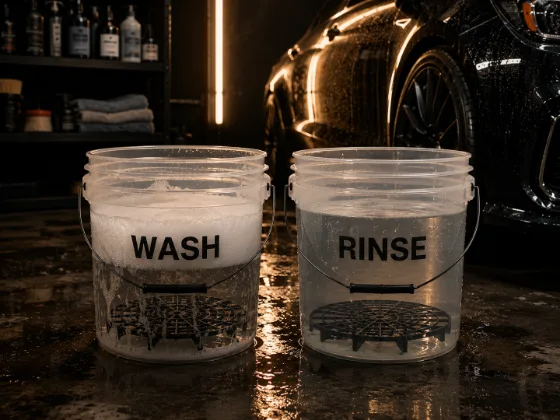
If there's one thing you take away from learning about proper car washing, make it this: use two buckets, not one.
That's it. That's the core of it. But the reason why is worth understanding, because once you understand the why, the rest of washing technique falls into place naturally.
The Problem with One Bucket
With a single-bucket setup, here's what happens at the molecular level (roughly speaking):
You load your mitt with soapy water and wash the hood. The mitt picks up road dust, brake dust, pollen, fine grit — all the stuff that's been accumulating on the paint since the last wash. Now the mitt is loaded with grit.
You dip the mitt back into the bucket to reload it with soap. In doing so, you dump some fraction of that grit into the bucket. Now your soapy water isn't just soap — it's a suspension of fine abrasive particles.
You reload the mitt and wash the next panel. The mitt picks up fresh soap water from the bucket — along with some of the grit that's now floating in it. You drag that grit-and-soap mixture across your clear coat.
Repeat across every panel, for every wash, for years. The result is the web of fine circular scratches across every painted surface that photographers call swirl marks.
The single-bucket method is a fine-grit sanding process disguised as cleaning. The soap makes it feel gentle while the grit does the damage.
How Two Buckets Fix This
The two-bucket method introduces a dedicated rinse bucket. Here's how it works:
Bucket 1 — Soap Bucket: Your shampoo solution. This is where you load the mitt with soapy water before washing each panel. The goal is to keep this water as clean as possible throughout the wash.
Bucket 2 — Rinse Bucket: Clean water only. No soap. This is where you rinse the mitt after each panel — before you go back to the soap bucket.
The sequence for every panel:
- Load the mitt from the soap bucket
- Wash the panel with straight-line motions
- Take the mitt to the rinse bucket
- Agitate it against the grit guard to dislodge particles
- Wring it out in the rinse bucket
- Go back to the soap bucket to reload
- Next panel
By rinsing the mitt in a separate bucket before reloading it from the soap bucket, you stop most of the grit from entering the soap water. The rinse bucket gets dirty. The soap bucket stays relatively clean.
This doesn't eliminate all contamination — some grit inevitably finds its way into the soap bucket anyway. But it dramatically reduces the amount of abrasive material riding in the water your mitt picks up and drags across the paint.
The Grit Guard
Both buckets should have a grit guard — a plastic insert that sits at the bottom of the bucket. It's a grid of squares, usually 12"x12", raised about an inch off the bottom of the bucket.
When you agitate your mitt against the grit guard, dirt and particles fall through the grid and settle below it, on the bucket floor. The grit guard prevents them from being stirred back up into the water when you move the mitt around.
Without a grit guard, the grit you rinse off your mitt just settles at the bottom and then gets churned back into suspension every time you dip the mitt in. With a grit guard, it stays below the grid and out of your way.
Grit guards cost a few dollars. They're one of the highest-value accessories in the entire process.
How to Set Up Correctly
Fill both buckets before you start. Soap bucket: water plus the correct amount of shampoo per the product's instructions. Rinse bucket: plain water, no soap.
Mark your buckets or get two different colors. It's surprisingly easy to confuse them when you're working quickly. Soap bucket = go, rinse bucket = stop and rinse.
Change the rinse water if it gets heavily contaminated before you finish. For a very dirty car, you might need to refresh the rinse bucket partway through.
Don't combine roles. Some people add a splash of shampoo to the rinse bucket "to help clean the mitt." This defeats the purpose. The rinse bucket is for rinsing, not for more soap.
Complement the Buckets with a Pre-Wash
The two-bucket method addresses what happens during the contact wash. But the smartest thing you can do for scratch prevention happens before you touch the paint at all.
A pre-wash chemical — applied to the wet car before you take out the mitt — chemically breaks down road film and surface contamination. Some of that contamination rinses off without ever being physically moved by a mitt. Less contamination on the paint when you start the contact wash means less grit available to scratch it.
Two buckets and a pre-wash together are the one-two combination that separates safe washing from scratch-producing washing.
A Word on the Mitt
The two-bucket method is most effective with the right mitt. A microfiber or lamb's wool wash mitt has long fibers that pull grit away from the paint surface and hold it inside the mitt rather than pressing it against the clear coat. A sponge has a flat surface that presses grit directly against the paint.
Rinse your mitt in the rinse bucket aggressively before reloading. The point isn't a quick dip — it's actively working the mitt against the grit guard to physically dislodge particles before they contaminate the soap bucket.
The Results Over Time
The two-bucket method isn't something you'll notice the first time you do it. You'll notice it after a year of consistent use.
Cars washed correctly over time retain their paint gloss without accumulating the steadily worsening haze that comes from swirl marks. Cars washed with single-bucket technique look increasingly dull no matter how often they're washed, because each wash adds more scratches than the last one removed.
The two-bucket method is free. It requires no new products, no expensive tools. Just two buckets, two grit guards, and the habit of rinsing the mitt before reloading it.
It's the single most impactful change most beginners can make.