
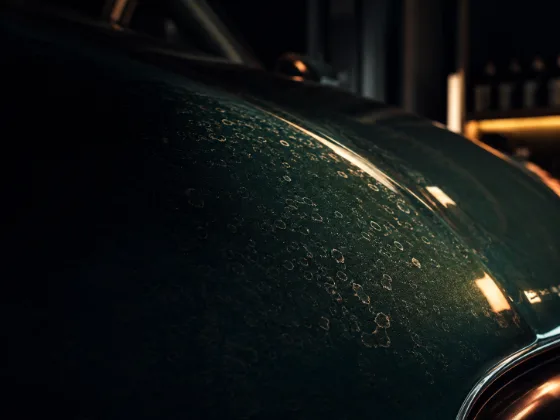
You rinse the car and there they are — white, chalky rings all over the paint. You run it through a wash and they don't budge. You try again with car shampoo and they're still there, maybe slightly faded but clearly not gone. At that point you're dealing with something soap and water can't fix, and the reason is chemistry.
Water spots that won't wash off aren't a cleaning problem. They're a chemistry problem. Once you understand what they actually are, the right removal method becomes obvious.
Not All Water Spots Are the Same
There are three distinct types of water spots, and they require three different approaches. Treating a Type 2 like a Type 1 wastes time. Treating a Type 3 like a Type 2 will disappoint you. Identifying which type you're dealing with before you start saves a lot of effort.
Type 1: Surface Mineral Deposits
This is the most common type. Water evaporates and leaves behind whatever minerals were dissolved in it — calcium, magnesium, silica, and other hard water compounds. They sit on top of the clear coat as a thin crusty film. They haven't bonded chemically to the paint. They haven't etched into anything. They're just sitting there.
Type 1 spots look white or grayish, sometimes with a visible ring shape. They may feel slightly rough under your fingertip. The key characteristic: they haven't penetrated the clear coat surface, which means the right chemistry will dissolve them without any abrasion needed.
Type 2: Etching
This is where things get more serious. When mineral-laden water sits on paint — especially in direct sun — heat accelerates the chemistry. The minerals don't just dry on the surface. They etch into the clear coat itself, leaving an actual physical depression in the paint.
The visual signature of etching is a water spot that has depth to it. It may look slightly recessed or have a frosted, matte appearance at the center. Running a clean fingertip over it, you might feel a faint indentation rather than just a rough bump. When you use a chemical water spot remover on Type 2 etching and wipe it off, the spot is still there — because the damage is mechanical, not chemical. You've removed any remaining mineral but the depression in the clear coat remains.
Type 2 requires polishing. You need to level the surrounding clear coat down to the depth of the etch. No chemical on earth will fill that depression back in.
Type 3: Bonded Scale
This is the severe end of the spectrum. Repeated exposure to hard water — especially irrigation water, which is often far harder than tap water — can build up multi-layer calcium and mineral scale that bonds tenaciously to the clear coat surface. You'll see this most often on cars that park near irrigation systems, or on vehicles that have sat for months without proper washing.
Type 3 deposits feel clearly textured. The surface may look almost rough or powdery. A single application of water spot remover won't touch it — you're dealing with something more like mineral scale on a shower door than a simple water stain.
How to Figure Out Which Type You Have
Start with a visual inspection in direct light. Shallow, ring-shaped white marks that look like they're sitting on the surface lean toward Type 1. Spots that look frosted or have a slightly sunken center suggest Type 2. Heavy, rough, opaque buildup points to Type 3.
Then do a finger-feel test on a clean panel. Type 1 feels gritty or rough like dried mineral residue. Type 2 may feel smooth but slightly recessed. Type 3 feels noticeably textured or crusty.
The definitive test is a water spot remover application. Apply a dedicated water spot remover product to a small test area, let it dwell, wipe it off, then look at the panel in direct light. If the spots are gone: Type 1. If the spots are reduced but still visible as faint marks: transitional or Type 2 with some surface residue. If the chemical had no effect: Type 3 or established Type 2 etching that needs polishing.
Why Car Wash Soap Does Nothing to Water Spots
Car shampoo is formulated to have a neutral pH — roughly 7 on the pH scale, or slightly above. This is intentional. Neutral-pH soap won't strip wax or sealants, won't react aggressively with paint, and is safe for regular use. These are good properties for a wash soap.
The problem is that mineral deposits — calcium carbonate, magnesium compounds, silica scale — are alkaline. Dissolving alkaline minerals requires an acidic solution. Neutral soap doesn't interact with them at all. You're pouring water on a chemistry problem that water created and hoping for a different result.
Dedicated Water Spot Removers
Water spot remover products work because they're mildly acidic — typically a dilute solution of citric acid, oxalic acid, or a similar organic acid. The acid reacts with the alkaline mineral deposits and converts them into water-soluble compounds that wipe away cleanly.
Application process for Type 1 spots: work in the shade on cool paint. Apply the product to a small area. Let it dwell for the time specified on the label — usually 30 seconds to 2 minutes, depending on severity. Wipe off with a clean microfiber. Don't let acidic products dry on the paint. Work in sections.
For heavier Type 1 or borderline Type 3 deposits, you may need to let the product dwell longer or apply it a second time. Some very stubborn mineral scale responds to a wet application under plastic wrap — the wrap keeps the product wet and extends contact time without letting it dry and potentially staining.
After any acid-based treatment, rinse the panel thoroughly with water and follow up with a wash to neutralize any remaining acid residue. Don't skip this step.
When You Need Polish Instead
If chemical treatment doesn't fully remove the marks, you're dealing with etching. Now the job shifts from chemistry to abrasion.
Polishing works by removing a thin layer of clear coat from the surrounding area, leveling the surface down to the depth of the etch. A finishing polish with a foam pad is the gentlest starting point for light etching. Deeper etch marks may need a more aggressive compound or pad combination.
Before you start polishing, do a paint thickness measurement. Aggressive polishing on thin clear coat can burn through. Knowing your clear coat thickness tells you how much working room you have. Anything under 3 mils of remaining clear coat should be approached carefully.
After polishing out etch marks, apply a sealant or wax to protect the freshly leveled clear coat. You've removed some protection along with the etch.
Dealing with Type 3 Bonded Scale
Heavy bonded scale often needs a two-step approach. Start with a water spot remover or a dedicated mineral deposit remover — these are formulated at a higher acid concentration than standard water spot removers. Let it dwell and agitate lightly with a soft applicator.
If the scale has been there long enough to partially etch into the clear coat, chemical treatment alone won't finish the job. Follow up the chemical step with a polish to level any remaining surface irregularity. For extreme cases on neglected vehicles, clay bar treatment after the chemical step can help lift stubborn bonded deposits before polishing.
Irrigation water spots are often the worst offenders because irrigation systems draw from groundwater or reclaimed water that can be significantly harder than municipal tap water. If a vehicle has been hit by sprinklers repeatedly, assume you're dealing with Type 3 until proven otherwise.
Prevention Is Simpler Than Treatment
The most effective prevention is time — specifically, drying the car quickly after washing or any water exposure. Water spots form when water evaporates and leaves minerals behind. If you remove the water before it evaporates, there are no minerals left behind. Rinse and dry after every wash. Park away from sprinkler zones.
Washing in direct sun is a major contributor. When you're soaping and rinsing a hot panel in bright sunlight, sections of the panel dry before you get back to them. Work in the shade or during cooler parts of the day.
After washing, a forced-air dryer or clean plush microfiber dries the car faster than letting it drip-dry. Drip-drying is how water spots form after a good wash — the water drips off slowly, pools in low areas, and evaporates on its own schedule.
Where Ceramic Coatings Fit In
Ceramic coatings don't prevent water spots. Minerals in water don't know or care that there's a coating present. What a ceramic coating does is make water spots significantly easier to remove.
On bare paint, mineral deposits have more surface texture to bond to and can begin chemically interacting with the clear coat faster. On a ceramic coating, the surface is harder, smoother, and chemically more inert. Water spots sit on top rather than bonding aggressively. A water spot remover works faster on a coated surface, and in many cases simple washing is enough to remove fresh spots that would have required more effort on unprotected paint.
The ceramic coating also buys you time. On bare paint in direct sun, you might have minutes before light water spotting starts to etch. A coating gives you a buffer before the chemistry becomes aggressive. It's not immunity — it's margin.
If water spots are a recurring issue at your location — hard water, sprinkler exposure, parking structure drips — a coating is one of the more practical investments you can make. You'll spend less time treating spots and more time preventing them.